Evening Tea Rituals: The Complete Guide to Winding Down at Night

Most writing about evening tea rituals promises something the tea cannot deliver. Calm on demand, sleep on request, a nervous system talked down by a hot drink. It is a nice idea, and it is not what happens. What actually happens is stranger and more useful: the cup changes the room you are sitting in, the pace you are moving at, and the way one night connects to the night before it. It does not work on you. It works on the conditions, and you follow the conditions without noticing you did.
That is the whole mechanism, and it is worth understanding because it changes how you build your evening ritual. If the tea were doing the work, the only question would be which tea. Since the hour is doing the work, the questions become better ones: when does the evening actually begin, what should the room feel like, how small can the ritual get before it stops holding, and what happens on the nights you have nothing left to give it. This guide is the complete answer, and it sits within the wider practice of drinking tea at night.
A Ritual Is Not a Routine
The distinction matters more than it sounds like it should. A routine is a sequence you complete: steps in an order, a thing you either did or did not do tonight. Which means a routine can be failed, and anything that can be failed will eventually be abandoned, usually on the exact evening you needed it most. An evening tea ritual is not that. It is a set of conditions you step into, and conditions do not have to be completed. They can be entered for two minutes or for an hour, and they hold either way.

What the conditions consist of is unglamorous. A pocket of time, deliberately marked. A room arranged so that nothing has to be decided. Something warm in your hands that cannot be rushed. A scent that will come to mean the end of the day because it has meant it many times before. That is the entire apparatus. There is nothing in it that acts on your body, and nothing that requires you to be in the right frame of mind before you begin.
What follows is that apparatus, taken apart. First, why an evening ritual works at all, in the body and in the mind. Then how to actually build one, at whatever scale your evenings can support. And finally, what is really doing the work once you are sitting there: the warmth, and the scent, and the strange fact that most of the effect is happening to the room rather than to you.
Why an Evening Ritual Works
Start with the moment itself. Evening is a real threshold, not just a time on the clock, and the strange thing about thresholds is that they pass unmarked unless something marks them. Left alone, the day simply bleeds into the night: the screens stay on, the pace never breaks, and at some point, you go to bed still moving at three in the afternoon's tempo. A warm cup is one of the oldest solutions to this, and a surprisingly effective one, because it gives the threshold a shape. More on that in how tea marks the transition from day to night.

Underneath the moment, the body is already doing something. Core temperature is falling. The nervous system is deciding, beneath any awareness of yours, whether the environment is safe enough to stand down. The mind, freed from the day's demands, is drifting into a mode that is often less restful than silence sounds. None of this is caused by tea, and it would happen without you. But it is worth knowing about, because it explains why some evenings settle and others refuse to, and it is covered in full in the science of slowing down before bed.
And then there is the part that has nothing to do with biology. Repeat a gesture at the same hour for long enough and it stops being a gesture. It becomes a marker, then a habit, and eventually something closer to an identity: this is what I do at the end of the day, this is how I close it. That accumulation is the reason a small ritual outlasts a large intention, and it is the subject of the psychology of nighttime rituals.
How to Build an Evening Tea Ritual
First start with when, because nothing else can be decided until that is. The ritual needs a boundary, an hour late enough that the day's obligations are behind you and early enough that you are not simply going to bed, and that single choice does most of the structural work. Pick it, hold it, and the rest of the ritual has somewhere to sit. The full case for treating that window as a designed container, rather than the leftover time before sleep, is in designing the closing hour of your day.

Then where. A ritual dies of friction more often than it dies of boredom, and friction is mostly logistical: the kettle is in the wrong room, the good mug is dirty, the chair has laundry on it. A small dedicated corner solves nearly all of this by being permanently ready, which means that at the end of a long day the only thing left to do is sit down. It does not require a spare room, or even a table, as setting up a cozy evening tea corner makes clear.
With the when and the where settled, the ritual itself is mostly a matter of sensory craft: the light you choose, the cup you like holding, the unhurried business of heating water and watching the color deepen. This is the pleasurable part, and it rewards attention, because a ritual you find beautiful is one you will keep. Creating an evening tea ritual walks through the whole sequence, from the setting to the first sip.
And then the honest part. Most evenings will not accommodate the full version, and a ritual that only works on good nights is not really a ritual. So the last thing to build is the smallest possible version of it, the two-minute one, the one that survives a bad day intact. Four simple evening rituals covers exactly that, and they are the ones you will use most.
How Warmth and Aroma Shape the Evening
Sit down with a cup at ten at night and two things start happening to the room, neither of which is happening to you. The first is warmth. The cup is now the warmest object in a space that has spent hours giving up its heat, which makes it conspicuous in a way it would not be at noon. It is also too hot to drink quickly, so it imposes a tempo: lift, sip, wait, breathe. And it is very often the only thing in a still, dim room that is actually moving, steam curling upward in slow currents that the eye follows without being asked to. None of that is physiology. It is just what a hot object does to a quiet space, and it is laid out fully in how warm tea shapes the atmosphere of your evening.

The second is scent, and scent is stranger. Research on ambient aroma has found that people describe the same unchanged room as warmer and more welcoming when a mild scent is present, often without noticing the scent at all. It reaches memory faster than sight does, which is why a familiar blend connects tonight to every night you have steeped it before. And it is the only element in the room that shapes the room while asking nothing of the person in it, not even their attention. That, more than anything else, is the answer to how an evening acquires its atmosphere, and it is the subject of how tea's aroma shapes a room at night.
Which is the whole thesis, arriving from two directions. Warmth works because you are holding it. Aroma works because you do not have to. Between them, the cup rearranges the conditions of the hour, and you follow the conditions, and the evening turns out to have had a shape after all.
How To Start an Evening Ritual Tonight
If you have read this far and want to actually do something about it, do not start with the full version. Almost everyone who tries to build the complete ritual on a Tuesday abandons it by Thursday, because the complete ritual assumes an evening you did not have.

Start with the smallest piece instead. Tonight, at whatever hour you can, boil water, make a cup, and hold it with both hands for thirty seconds before you drink any of it. That is it. That is a real evening ritual, in its entirety, and it will work whether or not you have a corner, a chair, a lamp, or an hour.
Then, if it holds for a week, add one thing. Pick the hour and keep it. Or clear a small surface and leave the kettle and the mug there so nothing has to be gathered. Or take the same cup to the same seat each night until the seat starts to mean something. Each of these is a single decision, and each one makes the next one easier. The complete ritual is not built in an evening. It accumulates, which is the only way anything like this ever survives.
Choosing an Evening Tea for Your Ritual
The honest answer is that the ritual works with almost anything warm. What it does not work with is a cup you are not looking forward to, because a ritual survives on wanting to return to it and nothing else. That is the whole reason the blend matters: not for what it does, but for whether it is good enough to keep you coming back on the nights you nearly skipped it.
Both of Purely's evening blends are built for exactly this hour. Caffeine-free, dessert-leaning, slow to finish, and aromatic enough that the room knows what you are doing before you have taken a sip.
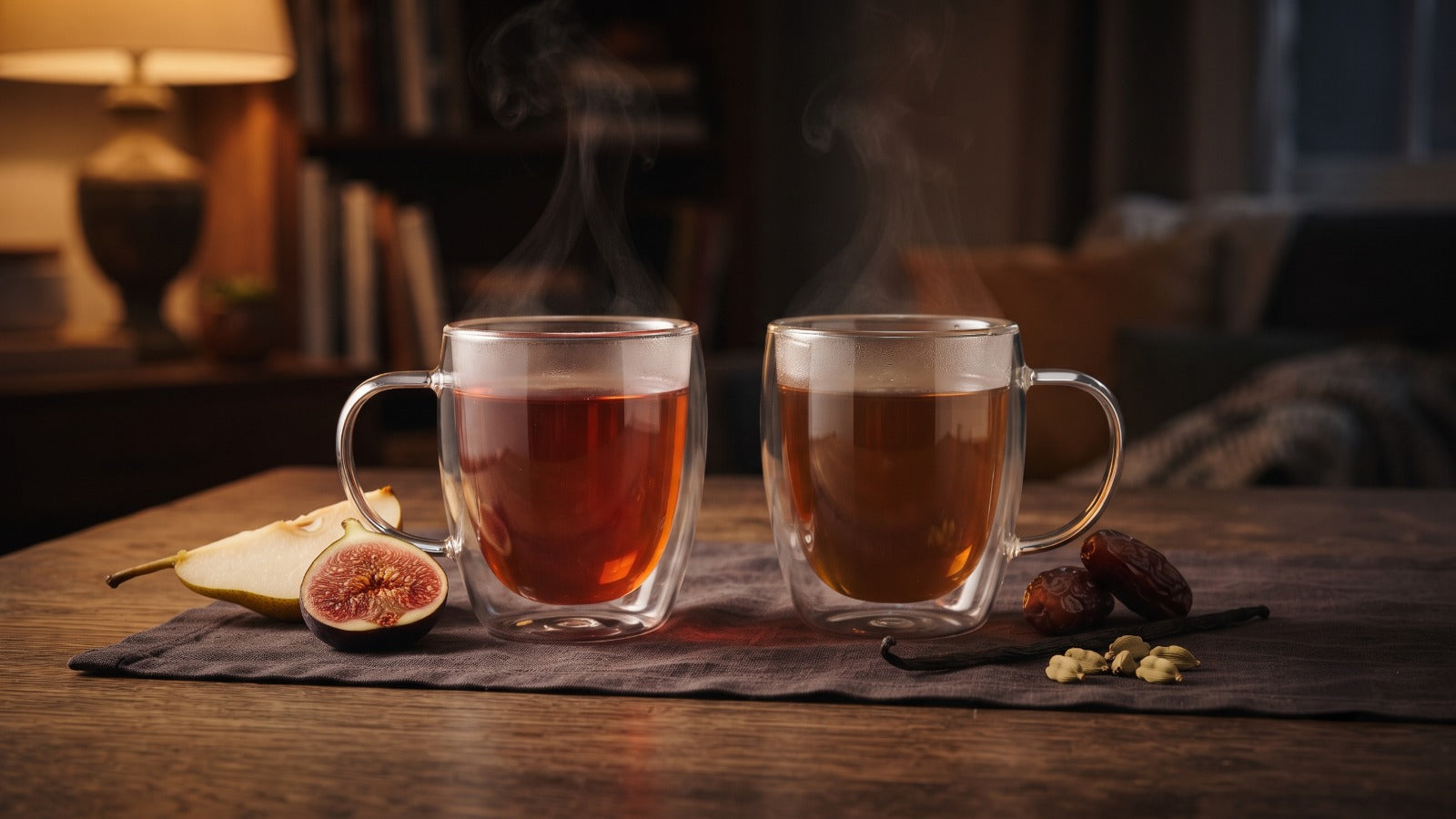
Sacred Sanctuary™ tastes like warm baked fruit lifted straight from the oven: ripe fig and soft pear folded into vanilla, jammy and rounded, sweet without weight. It suits an evening you want to feel light and open.
Moonlight Stillness™ goes darker and slower: honeyed date, vanilla, and a thread of warm cardamom, a cup that tastes the way a candlelit room feels. It suits an evening you want rich and enclosed.
Some nights call for one, other nights the other. The Evening Ritual Sampler carries both, so the evening never waits on a decision, whichever way you happen to be leaning.
What an Evening Ritual Can Actually Give You
Not calm, exactly. Not sleep, and not a nervous system talked into submission. What it gives you is smaller and considerably more reliable: an hour with edges, a room that has been arranged in your favor, a pace you cannot easily break, and the accumulating sense that the day has a place where it ends. You will not feel transformed. You will feel like the evening happened, rather than merely elapsed, which turns out to be the thing most people were actually missing.
And it holds. Not because it is powerful, but because it asks for so little that there is never a good reason to skip it. Boil the water. Hold the cup. Let the room do the rest.
Editorial Disclaimer
This content is for informational and educational purposes only. It reflects general perspectives on herbal tea, daily rituals, and related lifestyle practices. It is not intended to provide medical advice, diagnose conditions, or recommend treatments. Always consult a qualified healthcare professional with any questions about wellness or health-related matters.