Can You Drink Herbal Tea All Day?

Mostly yes, and the answer turns on what is in your blend rather than on a number. If you are drinking fruit, mint, chamomile, rooibos, or anything else on the ordinary end of the shelf, regulatory agencies regulate the safety of ingredients rather than setting a universal cup count, which leaves the limit to you. Some botanicals are a different matter, and licorice root is one of them, which is worth saying plainly because it is in our midday blends. What you have almost certainly run into first, though, is the figure of two to four cups a day, repeated so consistently across the internet that it reads as official guidance. It is not. It traces to a conditional remark made nearly a decade ago, about a different kind of tea entirely. For the broader framework for fitting herbal tea across the hours of the day, start with Drinking Herbal Tea Throughout the Day.
Where the "Two to Four Cups" Rule Came From
The figure traces to a single source. In December 2016, Today's Dietitian published an article called Medicinal Herbal Teas, and in a short section on safety it quoted Stefan Gafner, a pharmacist and chief science officer at the American Botanical Council. "The effects of herbal tea are usually mild," he said. "However, that doesn't mean you should drink a half gallon a day. Depending on what you're using it for, two to four cups a day is generally reasonable." That is the whole of it. One paragraph, in a trade magazine for dietitians, nine years ago.

Two things fall away between that paragraph and the version you find online. The article was about medicinal herbal teas, which is what the title says and what the rest of the piece is about, so the number was never offered as guidance for a fruit blend. And the figure was conditional. The condition was what you are using it for, which makes two to four cups a function of purpose rather than a ceiling. None of that makes the number wrong. It makes the number advice rather than a limit, and it means the useful question is the one it was answering: what is in the cup, and what are you drinking it for.
Why Licorice Root Is in Your Blend
Licorice root is the one botanical in our midday blends that comes with published guidance attached, and it is worth explaining why we use it before explaining what the guidance says. Licorice is genuinely sweet, considerably sweeter than sugar by weight, so a small amount does work that a lot of sugar would otherwise have to do. The compound responsible for both the sweetness and the guidance is glycyrrhizin, and the guidance is specific rather than general. The FDA lists licorice as generally recognized as safe in food under 21 CFR 184.1408, within stated maximum glycyrrhizin levels that vary by food category. In Europe, the Commission's Scientific Committee on Food proposed a provisional figure of no more than 100 milligrams of glycyrrhizin a day for regular intake, and some later risk assessments have argued for a more conservative threshold for sensitive individuals.

What the documented cases have in common is quantity. They describe people drinking licorice as the whole tea, several cups a day, over weeks, and in the reported cases the effects reversed once they stopped. That is a different thing from a few chips of root among eight other botanicals, and the distinction is quantity rather than plant. It is worth knowing all the same, particularly if you take medication for blood pressure or you are pregnant, in which case the sensible move is to ask a doctor rather than a tea company.
How Much Herbal Tea Per Day Is Reasonable?
Notice what the licorice guidance actually is. It is a figure for one compound in one botanical, published by bodies that looked at that compound and had something specific to say. There is no equivalent figure for herbal tea as a category, and that is not an oversight. A single number covering fruit, mint, rooibos, chamomile, and medicinal root at once would be useless, because those are not the same material and they do not behave the same way. So the question changes shape. Nothing in a fruit or mint blend forces a cutoff the way caffeine does, which means the interesting variable is not how many cups you have but which cup you have when. Four cups of the same evening blend, starting at breakfast, is a worse day than four different cups placed properly, and no safety literature anywhere has anything to say about that. It is not a question about volume. It is a question about fit.

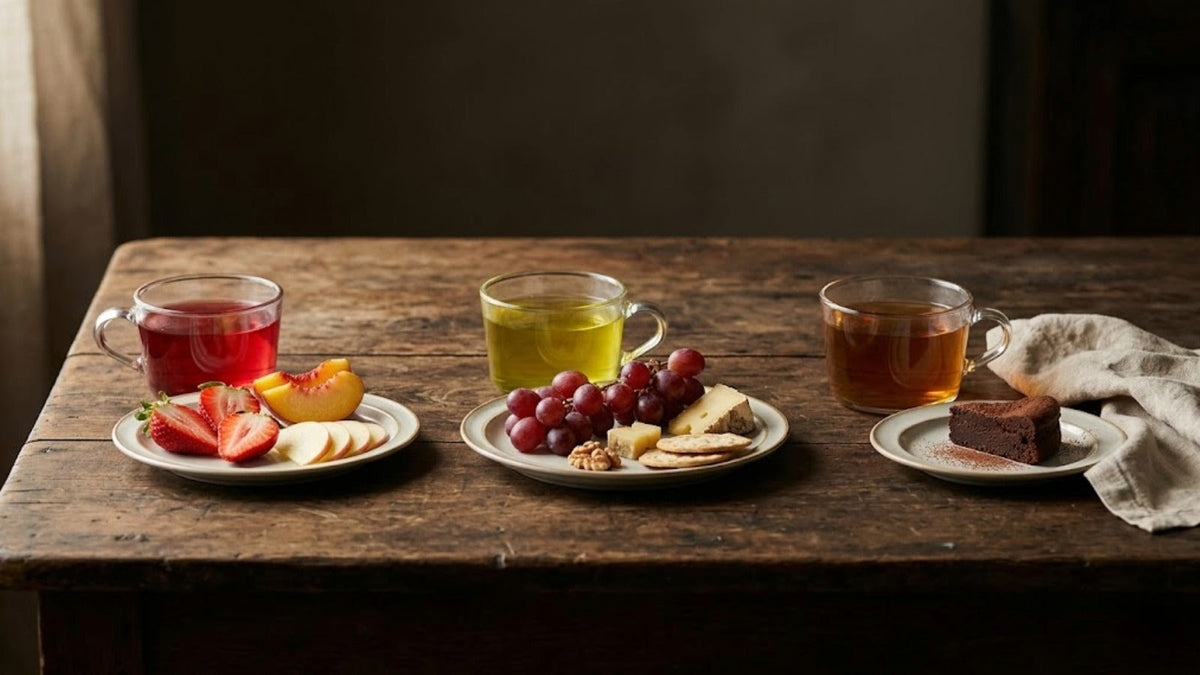
What we would drink instead is three different cups. Something fruit-forward early, bright and gently tart, when nothing has happened yet and a heavy cup lands wrong. Something mint-composed through the middle of the day, cool at the front with an earthier base underneath, for the hour when the afternoon has gone flat. Something dessert-inspired at the end, round and less tart, when the day is being set down. That progression follows the same three-phase rhythm: different botanicals for different parts of the day. The useful limit is not a count. It is your palate, and your palate does not want the same thing at nine at night that it wanted at seven in the morning.
So, Can You Drink Herbal Tea All Day?
Mostly yes. Read the label, and if a medicinal herb is sitting there as a main ingredient rather than a minor one, treat that blend as something other than an everyday drink and look it up somewhere better than a tea company's website. We have covered the one that appears in our own blends. Everything else on the ordinary shelf, the fruit and the mint and the rooibos and the chamomile, is a beverage, and the two-to-four-cups figure you keep meeting is a conditional remark from 2016 that escaped into the wild. What is actually worth paying attention to is which cup, and when. Nothing in a fruit or mint blend decides that for you, which is the whole reason it can follow you from the first cup of the day to the last one. For the broader foundation behind that approach, explore our guide to what herbal tea is, how it works, and when to drink it.
References
- McCulloch M. Medicinal Herbal Teas. Today's Dietitian, Vol. 18, No. 12, December 2016, p. 36. todaysdietitian.com
- US Food and Drug Administration. 21 CFR 184.1408: Licorice and licorice derivatives. ecfr.gov
- Healthline. What Are Licorice Root's Benefits and Downsides? healthline.com
Editorial Disclaimer
This content is for informational and educational purposes only. It reflects general perspectives on herbal tea, daily rituals, and related lifestyle practices. It is not intended to provide medical advice, diagnose conditions, or recommend treatments. Always consult a qualified healthcare professional with any questions about wellness or health-related matters.