Drinking Herbal Tea Throughout the Day

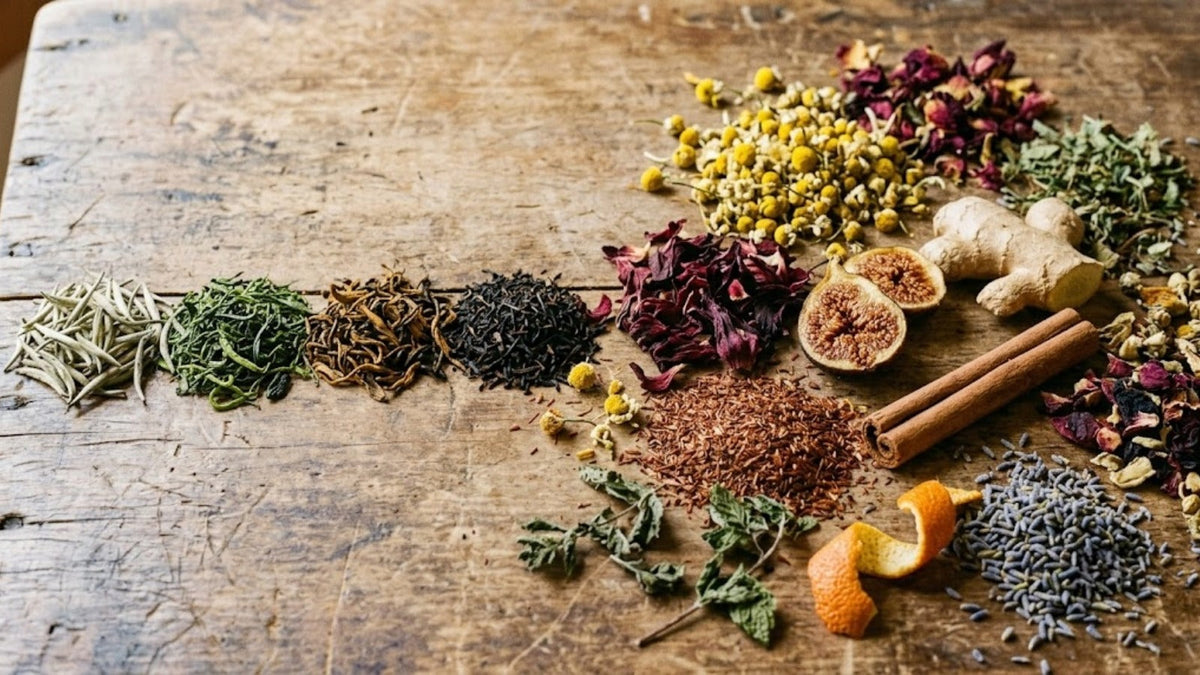
Ask most people what herbal tea is, and you will likely get a blank stare. Ask them to name a botanical, and the familiar answers are usually chamomile or lavender, two plants strongly associated with the evening. That is a large part of why herbal tea itself is so often treated as a bedtime drink. In reality, herbal tea spans a much wider world of herbs, flowers, fruits, roots, and spices, many of which lend themselves naturally to different moments of the day. And despite the name, herbal tea is not true tea from the Camellia sinensis plant at all.
It does not help that many herbal teas are marketed more like remedies than drinks, with a claim on the box and flavor treated as a secondary concern. So, the confusion is understandable. At Purely, we think about it more simply. Some botanicals make more sense in the morning, others through the middle of the day, and others in the evening. Sort them that way and the question stops being which botanical and starts being which part of the day you are in. And you do not need to become an herbalist. You just need to grasp which botanicals fit the moment you are in. If you want the broader foundation first, start with our guide to what herbal tea is, how it works, and when to drink it, then come back here for the full Morning, Midday, and Evening rhythm.
The Purely Botanical Rhythm Framework™
The Purely Botanical Rhythm Framework starts with the phase of your day, not with the individual botanical. Rather than asking what a particular herb, flower, fruit, root, or spice is supposed to do for you, we ask what kind of cup you actually want in the moment you are in and work backwards from there. The principle is simple: the moment comes first, and the botanicals are chosen to fit it.
The three phases have less to do with a specific hour than with where you are in the arc of your day. Morning is the opening, on rising, when you are starting the day deliberately and a bright, fruit-forward cup feels at home. Midday is the middle, when the brightness of morning gives way to the center of the day and the cup shifts toward something cool, refreshing, and contrasting. Evening is the closing, when you are setting the day down and the cup can become softer, rounder, and closer to dessert than to fruit.
Each phase is described along two axes. Sensory direction is the character of the cup and follows the palate: fruit-forward in the morning, mint-composed through the middle of the day, dessert-inspired in the evening. A dessert-like cup can feel heavy at the start of the day, while a sharply tart cup may feel out of place when the day is winding down. Botanical direction is the types of botanicals that create that character. The first decides the second.
| Phase | Sensory Direction | Botanical Direction | Examples |
|---|---|---|---|
|
Morning On rising |
Bright and light, gently tart, sits high on the palate | Juicy fruits, tart or fresh florals, clean herbal bases, warming accents | Strawberry, peach, pineapple, mango, green rooibos, hibiscus, elderflower, lemongrass |
|
Midday The middle of the day |
Cool over warm, cuts through rather than coats | Mints and aromatic herbs, citrus, fresh florals, grounding roots, gentle spice | Spearmint, peppermint, lemon peel, orange peel, lemon verbena, tulsi, osmanthus, dandelion root |
|
Evening Setting the day down |
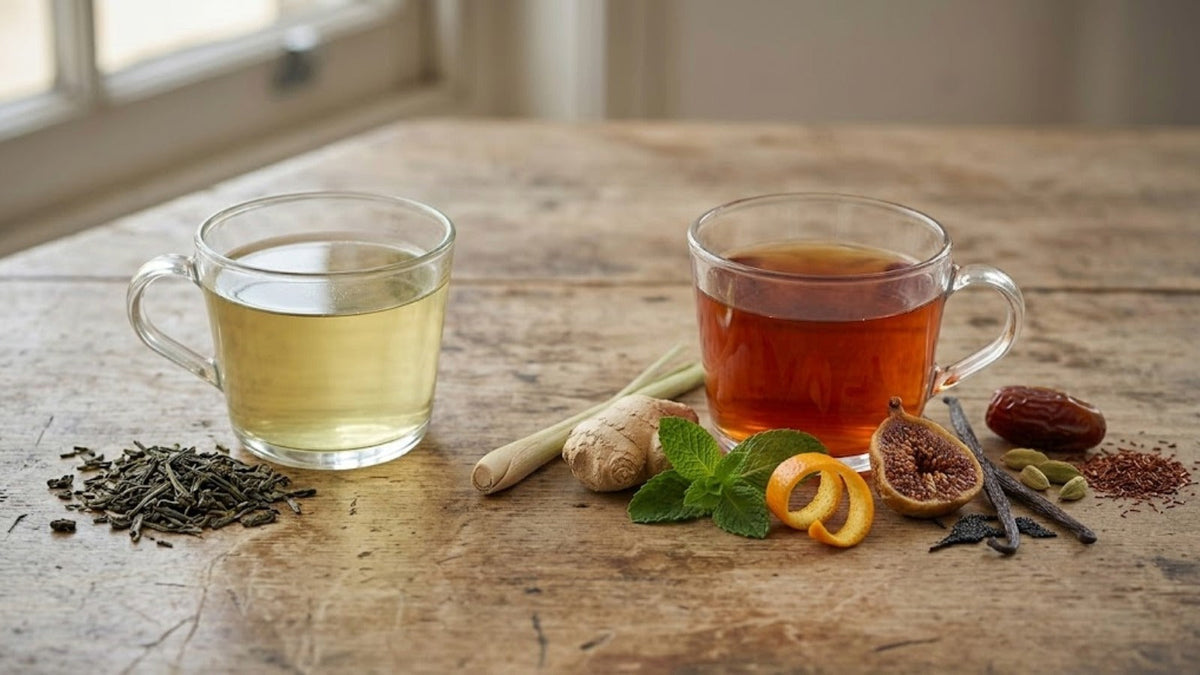
Round and less tart, coats the palate and stays | Round fruits, gentle florals, naturally sweet botanical bases, creamy or warming accents | Fig, pear, date, lavender, chamomile, red rooibos, honeybush, vanilla, carob, cardamom |
This is not a scientific classification, and no botanical is confined to one hour. The same plant takes on a different character depending on what surrounds it, which means the blend decides where it lands more than any single ingredient does. What the framework gives you is a direction: start with the phase, decide what kind of cup belongs there, and choose the botanicals from there. If you are wondering how that works across multiple cups, we look at the practical side in Can You Drink Herbal Tea All Day?
Morning: Fruit-Forward
Look at what people eat first thing and the pattern is already there. Juice, berries, half a grapefruit, jam on toast, fruit in yogurt. Nobody puts a slice of cake in front of you at seven in the morning, and nobody has to explain why. A morning cup follows the same logic. Strawberry, peach, apple, pineapple, and mango bring brightness and a gentle tartness without making the cup feel heavy. Hibiscus or elderflower lifts the fruit, lemongrass keeps the profile clean, and a base like green rooibos holds the whole thing together without adding weight.

The part that matters to us is that the fruit is real fruit. We dry ours in-house at low heat over many hours, which is slower and more expensive than the alternative, and the reason we do it is what happens in the water. A piece of slowly dried strawberry is quiet in the bag and keeps giving as the infusion develops, so the brightness carries from the first aroma through to the finish. That is a different cup from one built to smell fruity on opening, and the difference shows up most clearly in the morning, when there is nothing else on your palate for a thin cup to hide behind.
Midday: Mint-Composed
The middle of the day has its own pattern, and you probably already recognize it. The wedge of lemon in water, sorbet between courses, mint after a meal, something crisp when the afternoon has gone flat. All of those work by contrast. A midday cup works the same way: spearmint or peppermint arriving cool at the front, lemon peel or lemon verbena bringing brightness, and deeper botanicals underneath so the cup does not disappear after the first impression. If you are deciding how the cup should fit around food, we explore that separately in Herbal Tea Before or After Meals?

This is the phase where structure matters as much as the individual ingredients. Mint on its own is clean and immediate and then it is finished, because there is nothing underneath it. A root, cacao, or a little Ceylon cinnamon puts warmth below the cooling top notes and gives the finish somewhere to go. The mint leads and the deeper botanicals hold the cup up behind it. That cool-over-warm contrast is what makes a midday blend composed rather than simply minty, and it is what gives the center of the day a character of its own rather than a weaker version of the morning.
Evening: Dessert-Inspired
Dessert is not really a flavor. It is a position. It comes last, it is richer than what came before it, and it marks a change in pace. An evening cup occupies the same position, which is why the botanicals that suit it look nothing like the ones that suit seven in the morning. Fig, date, and pear bring round fruit character. Vanilla and carob add warmth. Red rooibos and honeybush give the cup body. Chamomile, lavender, and linden blossom bring softer floral notes, and cardamom sits underneath the blend the way spice sits beneath a pudding.

The distinction worth drawing here is between rich and sweet. A cup reads as dessert-inspired without being sugary, and it does that through weight rather than sugar. The fruit brings what sweetness there is. Honeybush and red rooibos give the infusion a fuller, rounder character, and a full cup comes across as sweeter than a thin one even when nothing has been added. Vanilla adds a familiar cue, since most of us meet its aroma in cakes and ice cream long before we meet it in a cup. The goal is not to reproduce dessert in liquid form. It is to borrow the qualities that make dessert feel like the natural close to something.
Start With the Moment
None of this asks you to learn forty plants. It asks you to notice which of three moments you are in, and they are moments you have understood your whole life without ever calling them a framework. Something bright at the beginning. Something fresh and contrasting through the middle. Something richer and rounder at the end. We already make those choices with food. Herbal tea happens to be able to follow the same shape through an entire day. If you want to turn one of those moments into something you return to consistently, start with How to Make Tea a Daily Habit.
That is the idea behind the Purely Botanical Rhythm Framework: start with the phase you are in, decide what kind of cup belongs there, and let the botanicals follow from it. Once you see herbal tea through the rhythm of the day rather than as a shelf full of unfamiliar plants, the category becomes much easier to navigate.
Editorial Disclaimer
This content is for informational and educational purposes only. It reflects general perspectives on herbal tea, daily rituals, and related lifestyle practices. It is not intended to provide medical advice, diagnose conditions, or recommend treatments. Always consult a qualified healthcare professional with any questions about wellness or health-related matters.