Herbal Tea vs Green Tea: Key Differences

Green tea comes from one plant, made from the leaves of Camellia sinensis, the same plant behind black, white, and oolong tea, and like all of them it carries caffeine. Herbal tea can be enjoyed as either a single botanical or an infusion of several: herbs, flowers, fruits, roots, and spices, and with rare exceptions is caffeine-free.
Most comparisons stop at that line and turn it into a scorecard: green tea's caffeine against herbal tea's calm. That framing misses what actually separates them when you're deciding what to drink. Green tea has a cutoff hour. Herbal tea doesn't, and that one fact changes how it fits into your day. For the broader botanical distinction behind this comparison, start with Herbal Tea vs Tea: Why They're Not the Same Plant.
Herbal Tea vs Green Tea: What Is the Difference?
| Feature | Herbal tea | Green tea |
|---|---|---|
| Plant source | Flowers, roots, bark, fruit, and leaves of many plants | Leaves of Camellia sinensis |
| Caffeine | None, aside from trace amounts in botanicals like cacao | Yes, moderate |
| Brewing | 205°F, 5 to 7 minutes, or longer | 160 to 180°F, 1 to 3 minutes, strictly |
| Flavor | Anything from tart hibiscus to sweet fig, depending on the botanical | Grassy and vegetal with a light astringency |
| Known for | Varies entirely by botanical | Catechins and L-theanine |
| Best time of day | Any hour, morning to night | Morning through mid-afternoon |
Herbal Tea vs Green Tea: Phases of the Day
The caffeine difference is real, but it is not the whole story. Green tea gives you one leaf and one flavor, and its caffeine sets the hour: it belongs to the morning and early afternoon, before a late cup starts to keep you up. Herbal tea works differently. With no caffeine to schedule around and a range that spans fruit, flower, root, and spice, it is the one category that can follow you from the first cup of the morning to the last one before bed.

That is the shift worth making. Bright and fruit-forward to start, cooling through the middle, soft and dessert-like to close. Seen that way, herbal tea stops being a catalog of botanicals to memorize and becomes a rhythm you move through. You are not learning a list of plants. You are reading the clock and letting the cup match the hour.
Herbal Tea vs Green Tea: Caffeine
Green tea runs about 30 to 50 milligrams of caffeine in an 8 oz cup, with the exact amount shifting by leaf, water temperature, and steep time. That is roughly a third of what you get from coffee and less than a cup of black tea. It is a moderate lift rather than a jolt, which is part of why green tea has the reputation it does: enough to feel, not enough to rattle you.
Herbal tea, with narrow exceptions, has none. No leaf from Camellia sinensis means no caffeine to speak of, which is the practical reason it reaches into the evening where green tea cannot follow. The number is worth knowing, but it is not really the question. The question is whether you want caffeine in the cup at all, and the honest answer changes by the hour, not by the tea.
Herbal Tea vs Green Tea: Flavor Profile
Green tea is not one flavor. How the leaf is heated to stop oxidation decides the cup, and that splits green tea into two broad camps. Japanese greens like sencha are steamed, which keeps them bright and grassy with a clean vegetal edge and sometimes a note like sea air. Chinese greens like gunpowder and dragon well are pan-fired instead, which turns them nutty and toasty, a little drier on the finish. Matcha sits apart from both, since you whisk the whole powdered leaf into the water rather than steeping and straining it. All of it is one plant. The range comes from the craft, not the botanicals.

Herbal tea has range too, but it works nothing like that. Green tea's variety is one leaf expressing itself under different heat. Herbal tea's variety is separate plants that share no common thread: hibiscus comes up tart and cranberry-sharp, peppermint cool and clean, chamomile soft with a note close to apple, fig round and almost caramelized. There is no single herbal flavor to describe because there is no single herbal plant. That is the part worth holding onto. With green tea you are choosing how one leaf was made. With herbal tea you are choosing which plant you want in the cup.
What Is Herbal Tea Made Of?
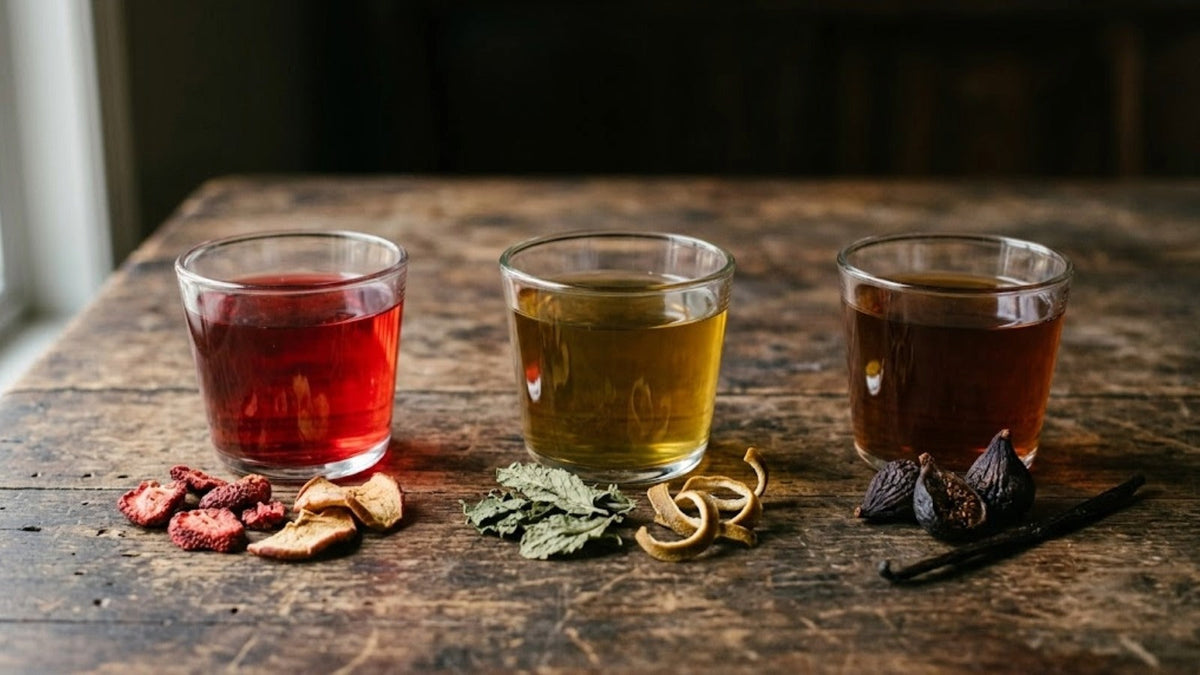
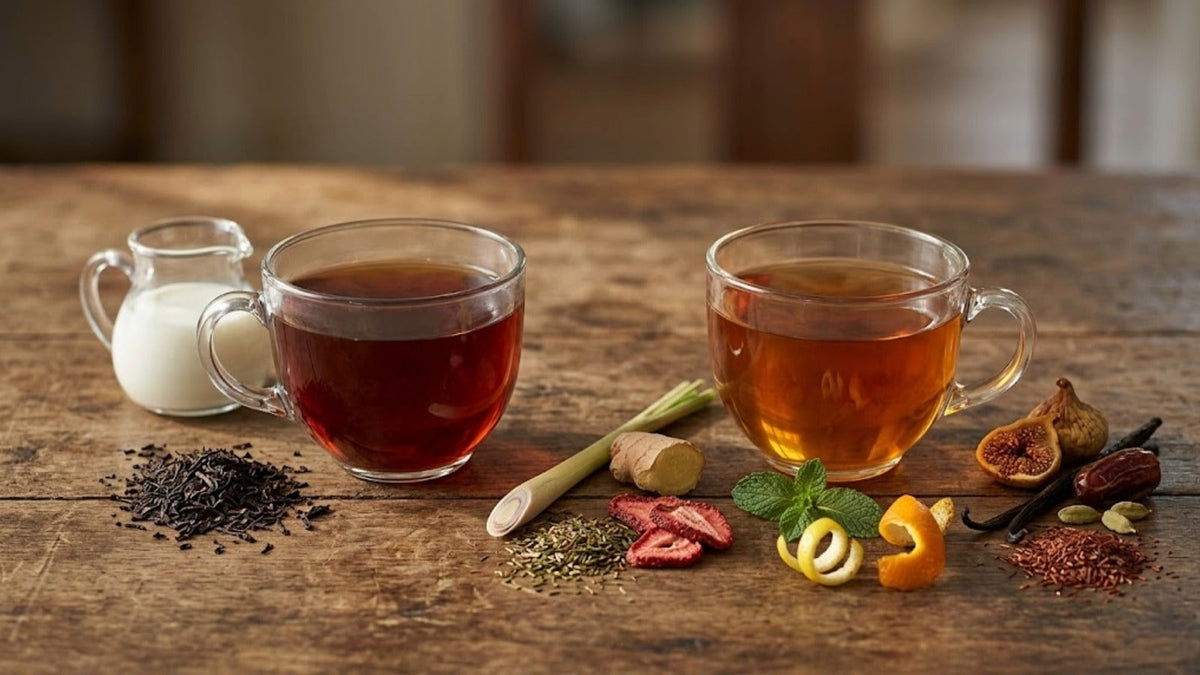
Most people picture fruit tea when they picture herbal tea, and that is where the confusion starts. The botanicals that define a cup are not the fruit. Lemongrass, ginger, and green rooibos make a morning cup bright and clean before a single berry is added. Spearmint and lemon verbena make a midday cup cool and reviving on their own. Chamomile, lavender, and red rooibos make an evening cup soft and slow with nothing else in the blend. Drink any of them alone and you still know what time of day it is. The botanical sets the hour. The fruit has not even entered yet.

Fruit is the layer, not the foundation, and any tea can carry it. What a crafted blend does is match the layer to the hour. Morning wants brightness, so fruit belongs there, which is why a good morning infusion tastes fruit-forward and most people assume that is all herbal tea is. Midday wants a reset, so cooling mint and warm spice play against each other. Evening wants dessert, so red rooibos, honeybush, vanilla, fig, and date do the work, sweet and round without a grain of sugar. That is the craft the fruit-tea assumption misses: the blend is built for the time you drink it.
Herbal Tea vs Green Tea: How to Brew Them
This is where the two teas ask different things of you. Green tea wants water well below boiling, around 160 to 180°F, and a short steep of one to three minutes. Pour boiling water straight onto green tea and you scorch the leaf, which floods the cup with tannins, the astringent compounds behind that dry, bitter finish. No thermometer needed: boil the kettle, take the lid off, and let it sit a few minutes before you pour. Green tea rewards attention. Miss the window on either temperature or time and the cup turns sharp.

Herbal tea asks for the opposite and forgives almost everything. Use water at a near boil, 205°F or so, and steep five to seven minutes, covered, so the aromatic oils stay in the cup instead of leaving with the steam. There is no Camellia sinensis leaf to scorch, so most blends will not turn bitter if you leave them longer. The five to seven minutes is a floor, not a ceiling. Want it stronger, steep it longer. That forgiveness is a large part of why herbal tea is the easier cup to make well, and why it suits the end of a long day when precision is the last thing on your mind.
Herbal Tea vs Green Tea: Which is Healthier?
Green tea is the more studied of the two, and that is a fact about the plant, not a verdict. Because every cup comes from the same leaf, it has one consistent makeup: catechins, the antioxidant group that includes EGCG, plus L-theanine, the amino acid that sits alongside its caffeine. That consistency is what makes green tea easy to research, and the reason it turns up in so much of the tea literature. Healthline covers the specifics in its evidence-based rundown of green tea's benefits.

Herbal tea cannot be summed up the same way, and this is where the usual comparison falls apart. There is no single herbal profile because there is no single herbal plant. Chamomile, hibiscus, ginger, and peppermint have almost nothing in common but the absence of caffeine, so what any herbal tea offers depends entirely on which plant is in the cup. That is why "which is healthier" is the wrong question. You can compare green tea to chamomile, or green tea to ginger, but not green tea to an entire category. For the plant-by-plant picture, WebMD's guide to herbal teas is a good place to start.
Herbal Tea vs Green Tea: Which Should You Drink?
The split is simple. Green tea is a morning-to-afternoon drink built on one leaf, one flavor family, and a caffeine level that sets its hours. Herbal tea is the whole day, a category wide enough to be bright at dawn and soft at midnight, with no cutoff to work around. Neither is the better tea. They are built for different parts of the day, and the useful question was never which one wins.
It is which hour you are in. Green tea if you want the lift and you are drinking it early. Herbal tea if you want a cup that follows you from the first light to the last, changing character as the day does. That is the logic the whole Purely daily ritual is built on: not one tea to rule them all, but the right cup for the hour you are in. For the broader foundation behind that approach, explore our guide to what herbal tea is, how it works, and when to drink it.
References
- Healthline. How Much Caffeine Is in Green Tea?.
- Healthline. 10 Evidence-Based Benefits of Green Tea.
- WebMD. Gallery of Herbal Teas: Types and Benefits of Herbal Teas.
Editorial Disclaimer
This content is for informational and educational purposes only. It reflects general perspectives on herbal tea, daily rituals, and related lifestyle practices. It is not intended to provide medical advice, diagnose conditions, or recommend treatments. Always consult a qualified healthcare professional with any questions about wellness or health-related matters.