Herbal Tea vs Black Tea: Key Differences

Black tea is made from the leaves of Camellia sinensis, the same plant behind green, white, and oolong tea. What sets black tea apart is oxidation: its leaves are left to fully oxidize before drying, which turns them dark and gives the cup its malty depth and its caffeine. Herbal tea is a different thing entirely, brewed from herbs, flowers, fruits, roots, and spices rather than the tea plant, and with rare exceptions it carries no caffeine at all.
Set side by side, the two are usually reduced to a single trade: black tea's strength against herbal tea's calm. That misses the difference that actually matters when you are deciding what to pour. Black tea carries caffeine, which gives it a natural cutoff later in the day. Herbal tea generally does not, so it can continue long after you might stop reaching for black tea. For the broader botanical distinction behind this comparison, start with Herbal Tea vs Tea: Why They're Not the Same Plant.
Herbal Tea vs Black Tea: What Is the Difference?
| Feature | Herbal tea | Black tea |
|---|---|---|
| Plant source | Flowers, roots, bark, fruit, and leaves of many plants | Leaves of Camellia sinensis |
| Caffeine | None, aside from trace amounts in botanicals like cacao | Yes, high |
| Brewing | 205°F, 5 to 7 minutes, or longer | 205°F, 3 to 5 minutes |
| Flavor | Anything from tart hibiscus to sweet fig, depending on the botanical | Malty and brisk, with a stronger astringency |
| Known for | Varies entirely by botanical | Theaflavins and tannins |
| Best time of day | Any hour, morning to night | Morning, best before noon |
Herbal Tea vs Black Tea: Phases of the Day
Caffeine is where most comparisons stop, but it is really where black tea's day begins and ends. Black tea is the morning cup by tradition, English Breakfast and its relatives built to start the day, and its caffeine keeps it there: it is the strongest of the true teas, which gives it the earliest cutoff of any of them. A cup after midday is a cup you may still feel at bedtime. Herbal tea carries no such clock. With nothing to schedule around and a range that runs from fruit to flower to root to spice, it is the one category that can follow you from the first cup of the morning to the last one before bed.

That is the reframe worth making. A morning wants brightness, the middle of the day wants something cooler, and the evening wants a cup closer to dessert. Herbal tea has a botanical for each of those, so the category stops being a long list of plants to sort through and turns into something simpler: a set of cups matched to the hours. You are not memorizing ingredients. You are picking the one that fits where you are in the day.
Herbal Tea vs Black Tea: Caffeine
A cup of black tea carries about 50 milligrams of caffeine, sometimes more, which makes it the most caffeinated of the true teas. It is still well short of coffee, which runs 90 to 200 milligrams a cup, so black tea reads as a steady lift rather than a hard jolt. But it is enough to matter late in the day, and it is the reason black tea belongs to the morning and starts working against you by the afternoon.
Herbal tea sits at the other end. With no leaf from Camellia sinensis in the cup, there is almost nothing to count, which is why an herbal tea at nine at night is an ordinary thing and a black tea at nine at night is a mistake you feel at midnight. The real question was never how many milligrams. It is whether you want any at all, and that answer moves with the clock.
Herbal Tea vs Black Tea: Flavor Profile
Black tea is not one flavor either, but its range comes from a different source than green tea's. Green tea splits by how the leaf is heated. Black tea splits by where it is grown, because once a leaf is fully oxidized, terroir does the rest. Assam, from the lowlands of northeast India, is the malty, full-bodied one, dark and brisk and built to take milk, which is why it anchors most breakfast blends. Darjeeling, grown high in the Himalayan foothills, is its opposite: light, floral, with a muscatel note like grape that earns it the nickname the champagne of teas, and it is best drunk plain. Ceylon, from Sri Lanka, lands between them, bright and citrus-edged. One plant, one process, and still three cups that share almost nothing.

Herbal tea reaches its range another way still. Black tea's variety is one leaf shaped by soil and altitude. Herbal tea's variety is different plants entirely, with nothing linking them but the pot they are brewed in: hibiscus tart and cranberry-sharp, peppermint cool and clean, chamomile soft with a note close to apple, fig round and almost caramelized. There is no single herbal flavor because there is no single herbal plant. That is the distinction to keep hold of. With black tea you are choosing where one leaf was grown. With herbal tea you are choosing which plant goes in the cup.
What Goes Into Herbal Tea?
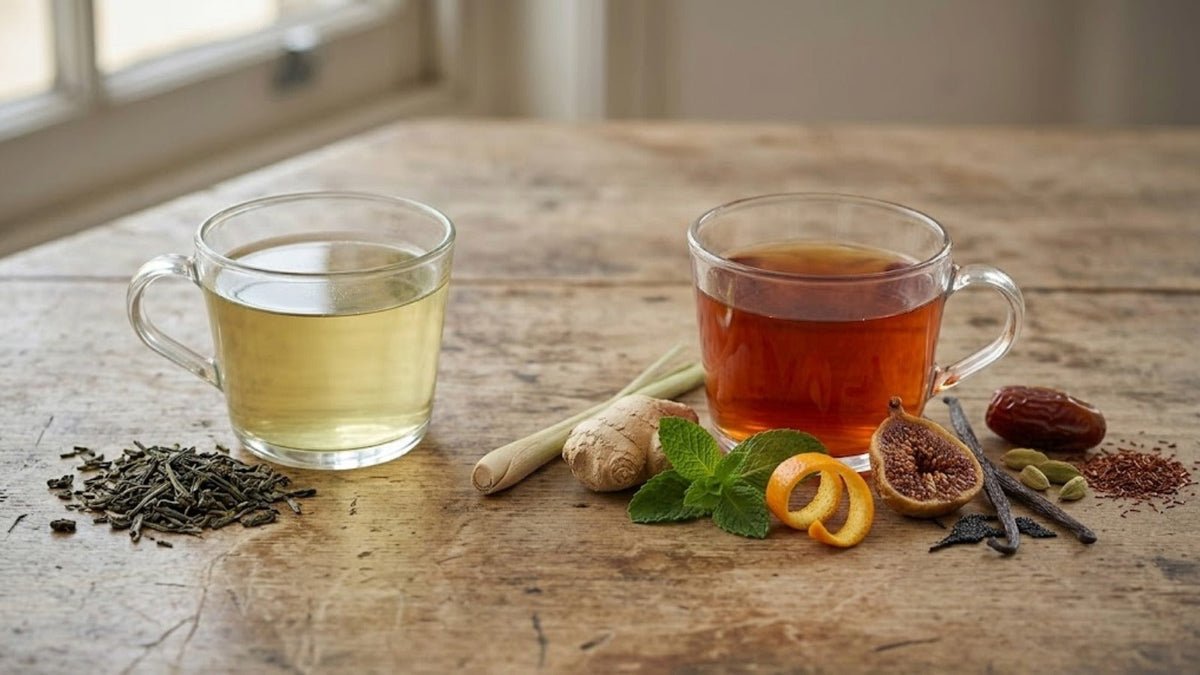
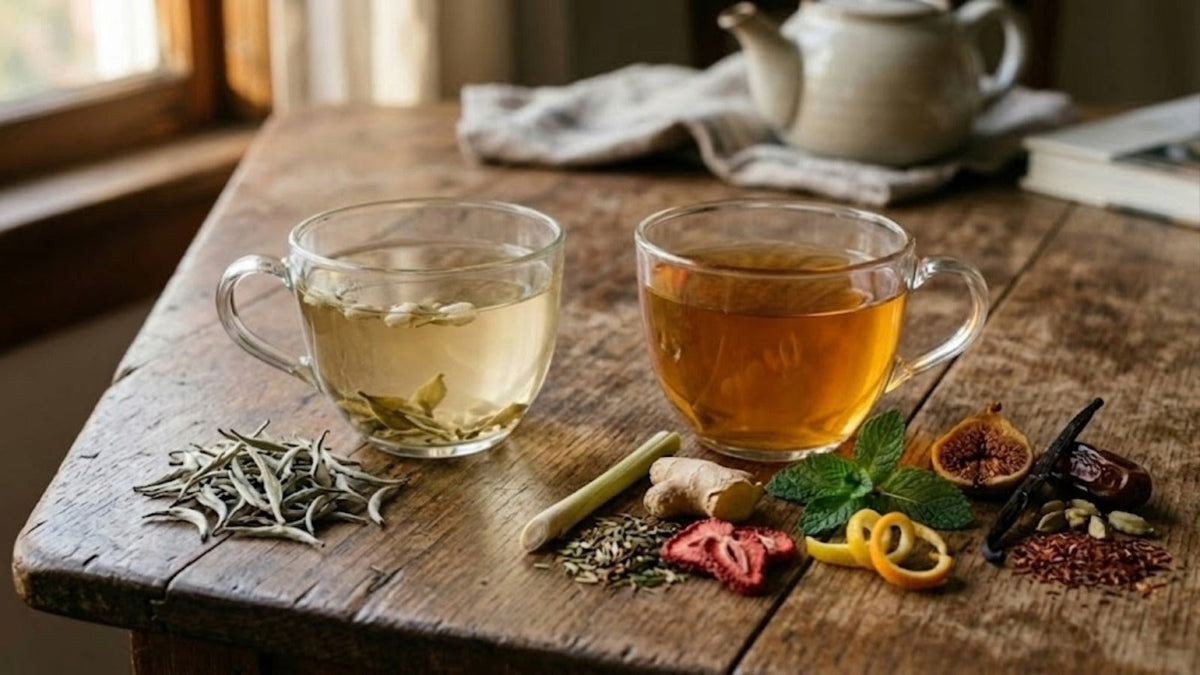
Black tea gets its range from one plant grown in different places. Herbal tea gets its range from the plants themselves, and there are a lot of them. That breadth is also where the confusion starts, because most people picture fruit tea when they picture herbal tea. The fruit is rarely what defines the cup. Lemongrass, ginger, and green rooibos make a morning blend bright and clean before a single berry is added. Spearmint and lemon verbena carry a midday cup cool and clear on their own. Chamomile, lavender, and red rooibos make an evening blend soft and slow with nothing else in the pot. Drink any of them alone and you still know the hour. The botanical sets it. The fruit has not entered yet.

Fruit is the layer, not the base, and any tea can carry it. What a crafted blend does is match the layer to the hour. Morning wants brightness, so fruit belongs there, which is why a good morning infusion tastes fruit-forward and why most people assume that is all herbal tea is. Midday wants a reset, so cooling mint plays against warming spice. Evening wants dessert, so red rooibos, honeybush, vanilla, fig, and date carry it, sweet and round without a grain of sugar. That is what the fruit-tea assumption misses: the blend is built for the hour you drink it.
Herbal Tea vs Black Tea: How to Brew Them
Here the two teas start out alike and then split. Both want fully boiling water, around 205 to 212°F, so temperature is not where they differ. Time is. Black tea holds heavy tannins, and past about four or five minutes those tannins over-extract and the cup turns dry and bitter. Leave the bag in while you get distracted and you will taste it. This is also why black tea is the tea that takes milk: its tannins bind to the casein proteins in milk, which softens the astringency and rounds the cup, the reason a strong Assam and a splash of milk belong together. Black tea gives you a window, and milk is the thing that widens it.

Herbal tea plays by looser rules. It brews at the same rolling boil, but with no Camellia sinensis leaf in the pot there are few of those biting tannins to over-extract, so most blends can sit for seven, eight, ten minutes and only grow deeper rather than sharp. Steep it covered so the aromatic oils stay in the water instead of drifting off with the steam, and steep it as long as you like the strength. Milk is the one place herbal tea is less forgiving: the acidic blends, anything heavy on hibiscus or citrus, will curdle a splash of milk on contact, which is why herbal tea is almost always a cup you drink clear. It asks less of your timing and, most nights, less of your attention.
Herbal Tea vs Black Tea: Which is Healthier?
Black tea is the more studied of the two, and that is a fact about the plant, not a verdict. Because every cup comes from the same oxidized leaf, it has one consistent makeup: theaflavins and thearubigins, the antioxidant groups that oxidation creates, alongside the caffeine and a measure of L-theanine. That consistency is what makes black tea straightforward to research, and the reason it fills so much of the tea literature. Healthline lays out what the studies actually say in its rundown of black tea's benefits.

Herbal tea cannot be measured the same way, and this is where the usual comparison comes apart. There is no single herbal profile because there is no single herbal plant. Chamomile, hibiscus, ginger, and peppermint share almost nothing but the absence of caffeine, so what any herbal tea offers depends entirely on which plant is in the pot. That is why "which is healthier" is the wrong question to ask. You can compare black tea to chamomile, or black tea to ginger, but not black tea to a whole category. For the plant-by-plant picture, WebMD's guide to herbal teas is a good place to start.
Herbal Tea vs Black Tea: Which Should You Drink?
The choice comes down to the clock. Black tea is a morning drink and makes no apology for it: one oxidized leaf, a bold malty character, and the highest caffeine of the true teas, which is exactly why it starts the day so well and why it has no business in your evening. Herbal tea runs the other way, a category wide enough to be bright at breakfast and soft at midnight, with no caffeine to schedule around. Neither is the better tea. They were built for different ends of the day, and the question was never which one wins.
It is which hour you are in. Reach for black tea when you want the lift and the morning is still ahead of you. Reach for herbal tea when you want a cup that stays with you as the day turns, bright to cooling to dessert. That is the whole idea behind the Purely daily ritual: not one tea for every moment, but the right cup for the hour you are in. For the broader foundation behind that approach, explore our guide to what herbal tea is, how it works, and when to drink it.
References
- Healthline. Caffeine in Tea vs. Coffee: How Do They Compare?.
- Healthline. Black Tea Benefits: What the Research Says.
- WebMD. Gallery of Herbal Teas: Types and Benefits of Herbal Teas.
- TeaTrade. Tannins in Tea: What They Are and What They Do.
Editorial Disclaimer
This content is for informational and educational purposes only. It reflects general perspectives on herbal tea, daily rituals, and related lifestyle practices. It is not intended to provide medical advice, diagnose conditions, or recommend treatments. Always consult a qualified healthcare professional with any questions about wellness or health-related matters.