Herbal Tea vs Tea: Why They're Not the Same Plant

Almost everything we call tea comes from a single plant. Green, black, white, oolong, the whole familiar shelf of them, are all leaves of Camellia sinensis, one species grown, picked, and processed in different ways. What looks like a wide variety of teas is really one plant wearing many forms. Herbal tea is not on that shelf at all. It is not another kind of tea but a different thing entirely, drawn from the rest of the plant world: the flowers, fruits, roots, barks, and leaves of countless other plants, none of them the tea plant, and almost none of them carrying caffeine. That is the real line between them. True tea is one plant in many forms. Herbal tea is every other plant you can put in a cup.
That distinction sounds academic until you notice what it does to your day. Because true tea is the caffeinated plant, every form of it keeps daytime hours, useful in the morning, fine through the afternoon, a problem too close to bed. Herbal tea has no such clock, because it never had the caffeine that sets one. It is the one category that can follow you from the first cup of the morning to the last before sleep, changing character as the hours do. That is the thread running through this whole comparison. For the broader picture, start with our guide to what herbal tea is, how it works, and when to drink it, then come back here for the botanical line that separates herbal tea from true tea.
What Is the Difference Between Herbal Tea and Tea?
The difference is the plant, and only the plant. Used strictly, the word "tea" names a single species, Camellia sinensis, and everything properly called tea comes from its leaves. Green, black, white, and oolong are not four different plants but one plant handled four different ways, the same leaf steamed or oxidized or dried or roasted into cups that can taste nothing alike. That is worth sitting with, because it means the enormous variety of true tea is all internal to one species. A brisk black tea and a pale, delicate white tea seem like opposites, yet they are the same leaf, separated only by what was done to it after picking.

Herbal tea sits on the far side of that line, and the line is drawn by botany, not by taste. An herbal tea, or tisane to use the precise term, is anything brewed like tea from a plant that is not the tea plant: chamomile flowers, peppermint leaves, ginger root, rooibos, hibiscus, a hundred others. This is why herbal tea has no single flavor, no single color, no single anything, because it is not one plant but a whole category of them. And the line holds no matter how the cup behaves. A bold, malty rooibos is still herbal tea, and a whisper-light white tea is still true tea, because the question was never how strong or how pale the cup is. It is only ever which plant it came from. Herbal tea is not a lesser tea or a failed one. It is everything else the plant world offers, which is a far larger place than a single species could ever be.
The True Teas: One Plant, Many Forms
If every true tea is the same leaf, what makes them taste so different is a single variable: oxidation, the process of letting the picked leaf react with air and darken, the same way a cut apple browns. Hold the leaf at one end of that range and you get one tea; let it run to the other and you get another. The four classic true teas are really four points along that one spectrum, from the leaf barely touched to the leaf taken all the way.

White Tea: the Leaf Barely Touched
White tea is the least handled tea there is, picked and dried before it can oxidize at all. Nothing is cooked, rolled, or transformed, which is why it stays the palest and most delicate of the four and tastes closest to the raw leaf. It is the starting point of the spectrum, the leaf left nearly as it grew.
Green Tea: the Leaf Halted Early
Green tea is heated soon after picking to stop oxidation before it can begin, which locks in the fresh, grassy character it is known for. Its range comes from how that heat is applied: steamed one way in Japan for a brighter, vegetal cup, pan-fired another in China for a nuttier, toasted one. Matcha belongs here too, green tea taken to its extreme, the whole leaf ground to powder and whisked into the water rather than steeped and strained.
Oolong Tea: the Leaf Half-Oxidized
Oolong tea sits in the wide middle of the range, partially oxidized, and because that middle is so broad it is less a single tea than a spectrum of its own. Stop the oxidation early and an oolong comes out floral and light, close to green; carry it further and roast the leaves and it turns dark, toasty, and closer to black. One leaf, one dial, turned wherever the tea maker chooses.
Black Tea: the Leaf Fully Oxidized
Black tea is the leaf taken all the way, left to oxidize completely before drying, which turns it dark and gives it the malty depth and brisk strength it is known for. At this end of the spectrum the leaf's origin does the fine-tuning, so where it grew, the lowlands of Assam or the hills of Darjeeling, shapes the cup as much as anything.
Line them up and the point makes itself. The gulf between a pale white tea and a bold black one is real, but it is not a difference of plants. It is one leaf, allowed to change a little or a lot. And for all that range, every cup on this spectrum shares the one thing oxidation never removes: caffeine. It lives in the leaf, so it is there whether the tea is barely processed or fully transformed, which is why all true tea, in all its forms, keeps to the daylight hours. Herbal tea is not another point on this line. It is off the line entirely, because it was never the same leaf to begin with.
What Is Herbal Tea Made From?
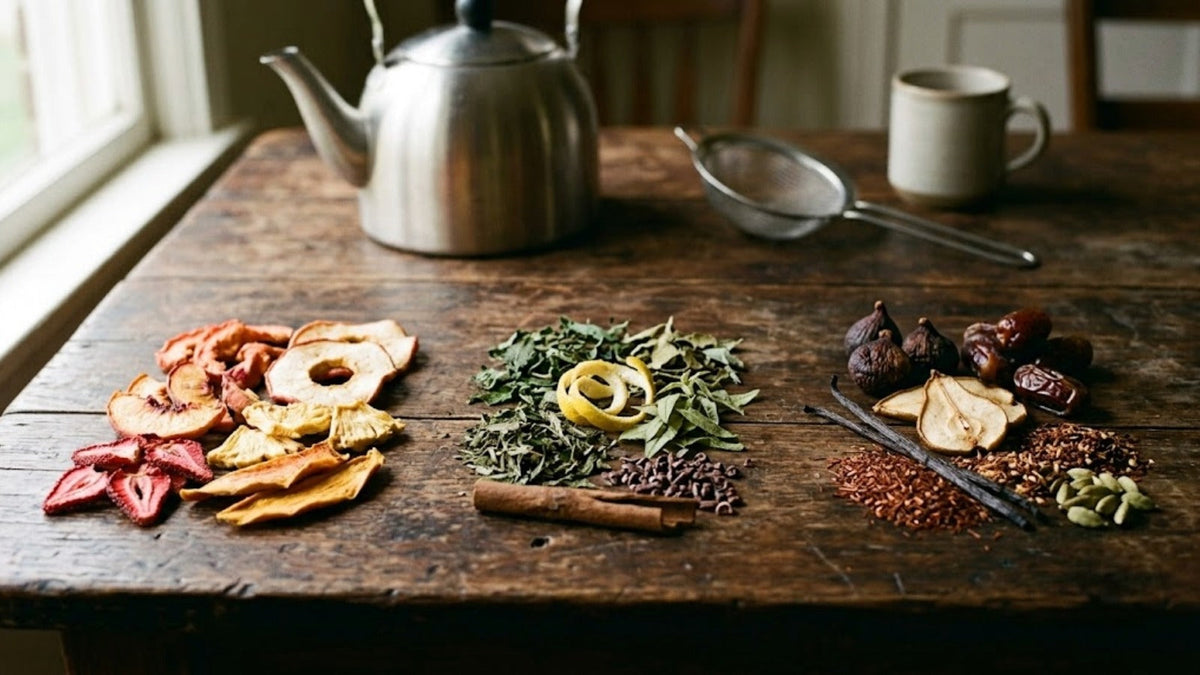
Here is where most people picture a few soothing flowers, chamomile and maybe peppermint, and stop. That is a fraction of it. Where true tea is one plant in four forms, herbal tea is very nearly the whole rest of the plant world, and almost every part of a plant can go into it. Flowers, like chamomile, hibiscus, and lavender. Fruits, like apple, fig, and berry. Leaves, like mint and lemongrass. Roots, like ginger, licorice, and rooibos. Barks and seeds and warming spices, like cinnamon and cardamom, the same ones that, layered onto a black tea base, make chai. There is no short list that captures it, because the category is not a list of plants. It is nearly all of them.

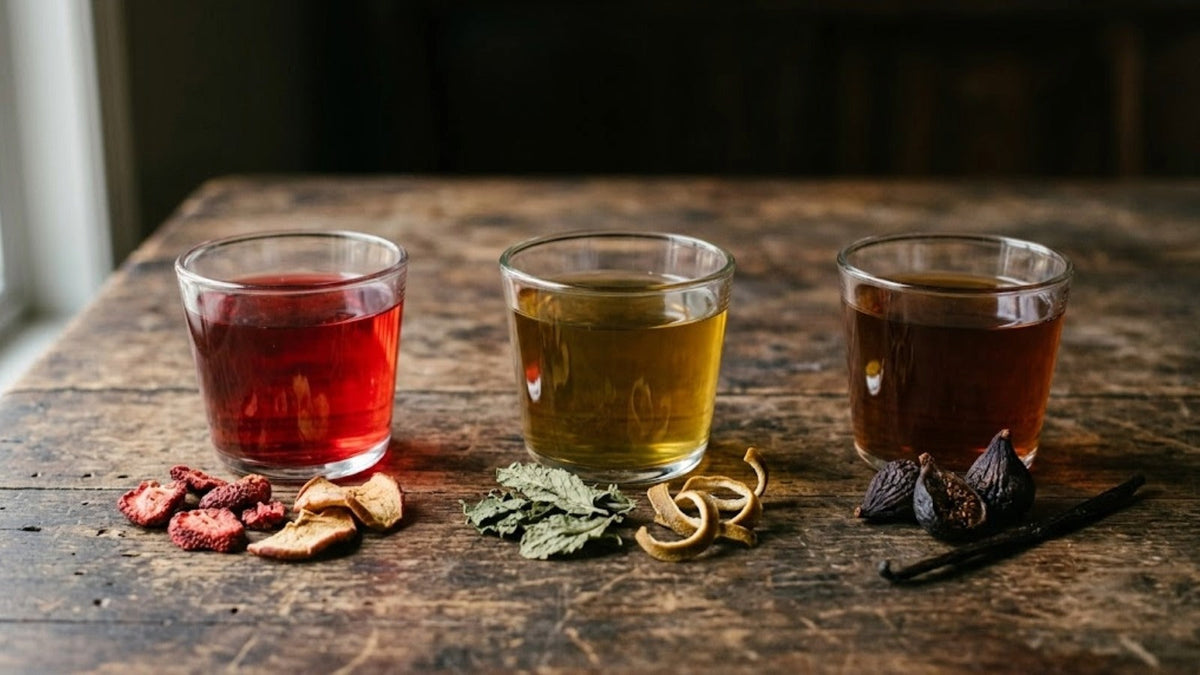
That breadth is the whole point, and it is the exact mirror of true tea. True tea takes one plant and draws four cups from it, deep variety within a single species. Herbal tea does the opposite: it takes a hundred unrelated plants and asks nothing of them but that they steep. This is why herbal tea has no single flavor, no signature note, no one thing it tastes like, because there is no one plant behind it to have a taste. A tart hibiscus and a soft chamomile and a sweet, rounded fig share nothing but the pot. What looks at first like a vague, catch-all category is really the opposite of vague. It is the widest range of flavor any cup can offer, a different one for every mood and, as it turns out, every hour of the day.
Does Herbal Tea Have Caffeine?
No, herbal tea is caffeine-free, with only trace exceptions from botanicals like cacao. That is the clean line between the two categories, and it holds because caffeine lives in the tea leaf itself. Every true tea carries it, in every form, and the range runs higher than most people expect. Matcha is the most caffeinated of all, because you whisk and drink the whole ground leaf instead of steeping and discarding it, taking in everything it holds at once. At the other end, even decaffeinated tea keeps a small trace: the process strips most of the caffeine from the leaf but never the last of it, so decaf gets close to caffeine-free without ever reaching the zero herbal tea starts at. From decaf's near-nothing to matcha's high, true tea is never actually none. Herbal tea is the only cup that is.

That single fact is what turns a botanical distinction into a practical one. Because every true tea carries caffeine, every true tea keeps daytime hours: welcome in the morning, fine through the afternoon, a quiet mistake too close to bed. Herbal tea has no such cutoff, because it never had the caffeine that creates one. It is the one category that can carry you across the whole day, bright in the morning and soft at night, without a single hour it has to avoid. The difference between the two was never really about the plant on its own. It is about which cup you can reach for, and when.
Which Is Healthier, Herbal Tea or Tea?
True tea is the more studied of the two, and that follows directly from what it is. Because every true tea comes from a single plant with one consistent makeup, it is straightforward to research: the same leaf, measured again and again, which is why it fills so much of the tea literature. That is a fact about how easy true tea is to study, though, not a verdict that it is better for you. It simply holds still long enough to be measured. For what the research says about the true teas, WebMD's overview of tea's health benefits is a good place to start.

Herbal tea cannot be measured on the same scale, and by now the reason is familiar. There is no single herbal profile because there is no single herbal plant. Chamomile, ginger, hibiscus, and peppermint share nothing but the pot they steep in, so what any herbal cup offers depends entirely on which plant is in it. That is why "which is healthier" is the wrong question to ask of the category. You can weigh true tea against chamomile, or against ginger, but not against a whole plant kingdom at once. For the plant-by-plant picture of what individual botanicals offer, WebMD's guide to herbal teas is a good place to start.
Herbal Tea vs Tea: Which Should You Reach For?
So, the difference was never really a contest. True tea is one plant, Camellia sinensis, turned by processing into green, black, white, oolong, and the rest, every one of them carrying the caffeine that keeps it to the daylight hours. Herbal tea is everything else the plant world offers, a whole kingdom of flowers, fruits, roots, and leaves, caffeine-free by nature and free of any hour it has to avoid. You do not have to choose between them, and the question was never which is better. It is which one the moment calls for: true tea when you want the lift and the day is still ahead of you, herbal tea when you want a cup that asks nothing of the clock and can carry you all the way to the end of it.
References
- WebMD. Tea: Are There Health Benefits? Pros and Cons, Benefits, and Nutrition Information.
- WebMD. Gallery of Herbal Teas: Types and Benefits of Herbal Teas.
Editorial Disclaimer
This content is for informational and educational purposes only. It reflects general perspectives on herbal tea, daily rituals, and related lifestyle practices. It is not intended to provide medical advice, diagnose conditions, or recommend treatments. Always consult a qualified healthcare professional with any questions about wellness or health-related matters.