Herbal Tea vs Matcha: Key Differences

Matcha is green tea, but not in any form you would recognize from a teacup. Where ordinary green tea is steeped and strained, so you drink an infusion and throw the leaves away, matcha is the whole leaf itself, stone-ground into a fine powder and whisked into the water until nothing is left behind. You are not drinking what soaked out of the leaf. You are drinking the leaf. That single difference is why matcha is thicker, greener, stronger, and far higher in caffeine than the green tea you steep. Herbal tea sits somewhere else entirely, brewed from the flowers, fruits, roots, and leaves of plants that have nothing to do with the tea bush, and, with rare exceptions, carrying no caffeine at all.
That is the line that matters when you are deciding what to reach for. Matcha carries more caffeine than black, oolong, white, or ordinary steeped green tea, because drinking the leaf whole delivers all of it at once instead of the fraction that soaks out in a cup. That makes it a morning drink with an early, firm cutoff. Herbal tea has no cutoff to worry about. It is the cup with no wall at the end of the afternoon, the one that carries from the first hour of the day to the last, and that is the difference worth holding onto. For the broader botanical distinction behind this comparison, start with Herbal Tea vs Tea: Why They're Not the Same Plant.
Herbal Tea vs Matcha: What Is the Difference?
| Feature | Herbal tea | Matcha |
|---|---|---|
| Plant source | Flowers, roots, bark, fruit, and leaves of many plants | Whole Camellia sinensis leaf, ground to powder |
| Caffeine | None, aside from trace amounts in botanicals like cacao | Yes, very high |
| Brewing | 205°F, 5 to 7 minutes, or longer | Whisked into water, not steeped |
| Flavor | Anything from tart hibiscus to sweet fig, depending on the botanical | Intense, grassy, and umami-rich, with a creamy finish |
| Known for | Varies entirely by botanical | Concentrated catechins and L-theanine |
| Best time of day | Any hour, morning to night | Morning |
Herbal Tea vs Matcha: Phases of the Day
Matcha is a morning drink, and it does not pretend otherwise. A serving carries around 60 to 70 milligrams of caffeine, more than a cup of steeped green tea and closing in on coffee, because you drink the whole ground leaf instead of an infusion of it, so you take in all the caffeine at once rather than the part that leaches into hot water. Matcha's admirers will tell you its energy feels smooth, a calm, focused lift rather than a jolt, and they are right, thanks to an amino acid called L-theanine that paces the caffeine out over hours. But smooth energy is still energy. A calm, focused lift at nine at night is still a lift you will feel at midnight, which is why matcha belongs to the start of the day and stays there. Herbal tea belongs to none of that. It has no caffeine to pace out, smooth or otherwise, and no hour it has to clear.

That is what herbal tea offers instead: a cup for every part of the day rather than one strong start to it. Something bright for the morning, something cooling for the middle of the afternoon, something soft and close to dessert for the evening. You are not learning a shelf of unfamiliar plants. You are letting the hour pick the cup.
Herbal Tea vs Matcha: Caffeine
The short version came up already: matcha is the caffeinated one, and a good deal more caffeinated than steeped green tea. The longer version is worth a moment, because matcha's caffeine has a range wider than any other tea, and the reason is that you control it directly. Matcha holds roughly 19 to 44 milligrams of caffeine per gram of powder, and a serving runs anywhere from half a teaspoon to a full one. Whisk a light half-teaspoon and you land near 40 milligrams, gentler than a cup of coffee. Whisk a heavy full teaspoon of a strong powder and you can clear 150, well past it. With a steeped tea the leaf-to-water ratio is more or less fixed for you by the bag or the scoop. With matcha you are spooning the caffeine in yourself, so the dose is unusually in your hands, for better or worse.
Herbal tea takes the whole question off the table. There is no powder to measure heavy or light, no ratio to get right, nothing to dial up or down, because there is no caffeine in the pot to begin with. Whatever you scoop, however long it sits, the number stays zero. That is the quiet advantage of the cup that never had caffeine in it: there is nothing to manage.
Herbal Tea vs Matcha: Flavor Profile
Matcha tastes like green tea taken to its extreme, and that is the whole-leaf again: you are drinking the concentrated leaf, not a light infusion of it. The grassy, vegetal note of green tea is there, but louder, and underneath it runs a deep savory quality the Japanese call umami, the same brothy richness you get from miso or good stock. Good matcha finishes with a natural sweetness and only a faint edge of bitterness. Lesser matcha, the culinary grade meant for lattes and baking, leans harder into that bitterness and the raw grass, which is why the ceremonial grade, made from the youngest shaded leaves, costs more and is the one meant to be drunk plain. And then there is the texture, which no steeped tea has: whisked hard, matcha turns thick and frothy, with a creamy, almost velvety body. It is closer to a thin broth than to the clear water of a brewed cup. You do not just taste matcha. You feel it.

Herbal tea has range too, but it is the opposite kind of range. Matcha is one leaf turned all the way up, a single powerful note, concentrated and whole. Herbal tea is not one thing intensified but many different things side by side: hibiscus tart and cranberry-sharp, chamomile soft and apple-like, peppermint cool and clean, fig round and almost caramelized, none of them related to the others by anything but the pot they are brewed in. Matcha gives you the whole of one plant, as much of it as a cup can hold. Herbal tea gives you your pick of dozens. With matcha you are drinking one leaf, completely. With herbal tea you are choosing which plant you want in front of you.
What Herbal Tea Is Made Of
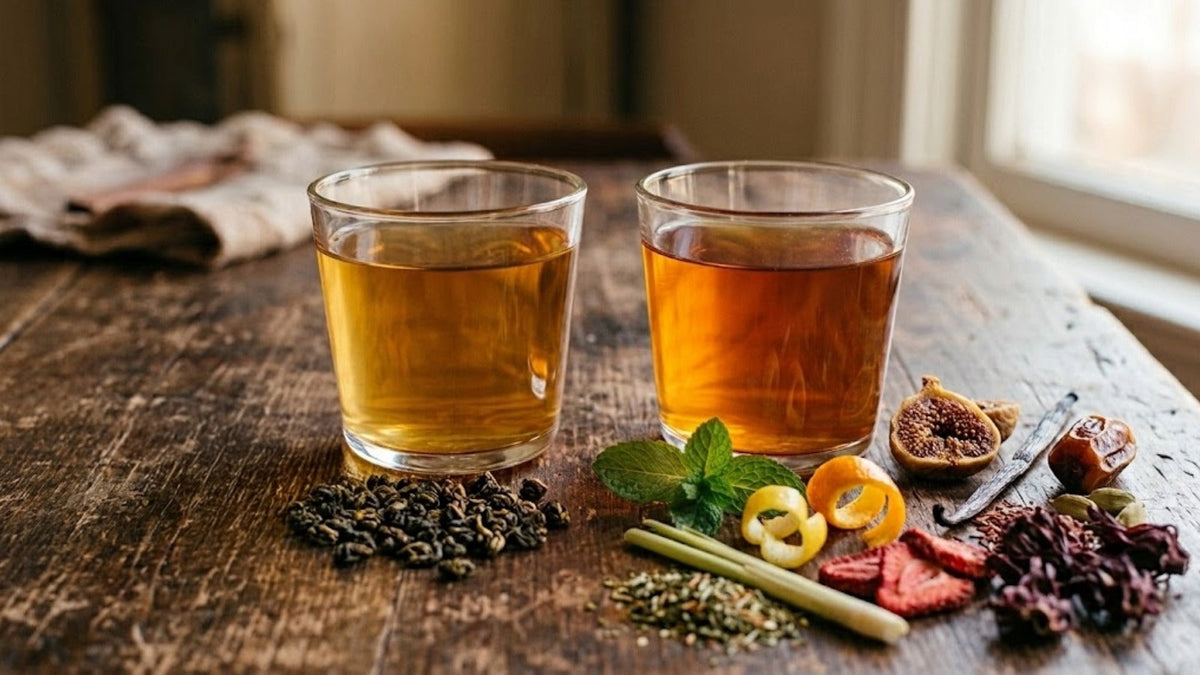
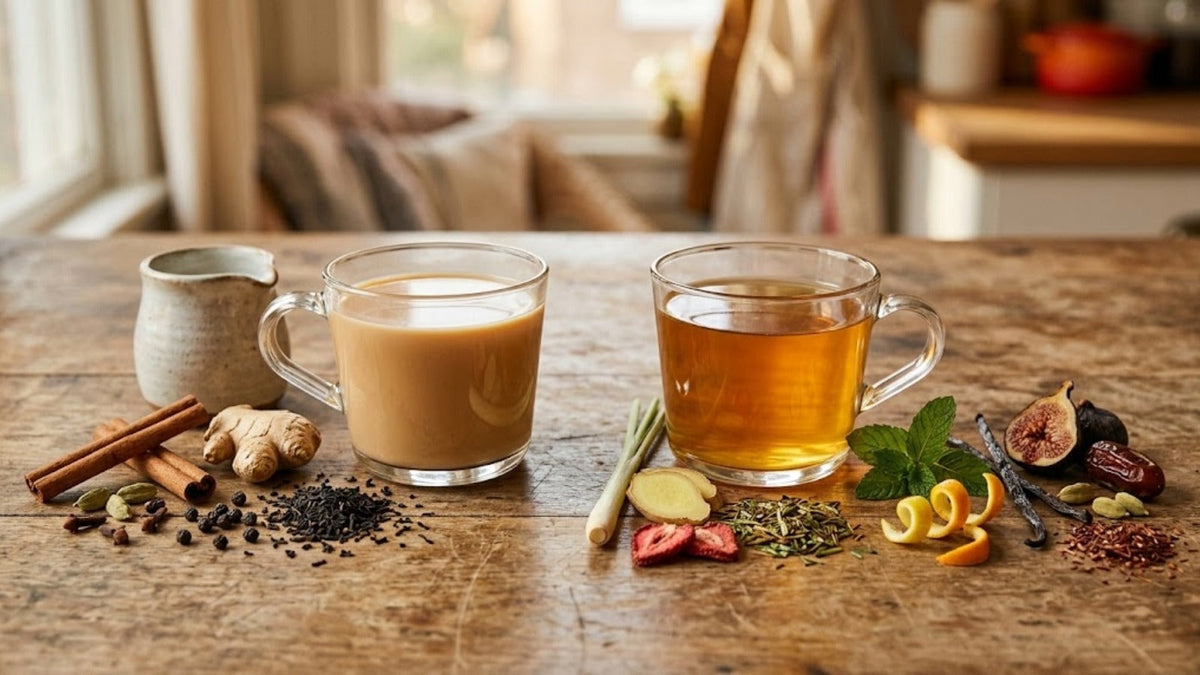
Matcha is one plant taken to its fullest. Herbal tea is the opposite approach to range, drawn from many plants rather than one, and that breadth is where people misread it, because the first thing they reach for to describe it is fruit. Fruit is rarely what defines the cup. Lemongrass, ginger, and green rooibos wake a morning blend up, bright and clean, before a single berry is added. Spearmint and lemon verbena keep a midday cup cool and clear on their own. Chamomile, lavender, and red rooibos settle an evening blend into something soft and slow with nothing else in the pot. Brew any one of them alone and you can still name the hour it belongs to. The botanical sets that. The fruit has not arrived yet.

Fruit is the top note, then, not the foundation, and any tea can carry it. What a good blend does is fit that fruit to the hour it is meant for. Mornings want brightness, so fruit belongs there, which is why a well-made morning cup tastes fruit-forward and why most people assume fruit is the whole story. Middays want a reset, so cool mint plays against warm spice. Evenings want dessert, so red rooibos, honeybush, vanilla, fig, and date carry the cup, sweet and round without a grain of sugar. That is what the fruit-first idea misses: a blend is built for the time of day you reach for it.
Herbal Tea vs Matcha: How to Brew Them
You do not brew matcha. You whisk it. There is no steeping and no straining, because there is no leaf to remove: you sift the powder into a bowl, pour water heated to around 175°F, and whisk it briskly in a W or M motion until a fine foam forms on top. The water matters. Fully boiling water scalds the powder and turns it bitter, so you let the kettle rest a minute before pouring, the same care green tea asks for. And there is no second cup from the same measure, because the leaf is not steeped and set aside, it is dissolved and drunk. One whisk, one bowl, the whole leaf gone into the water. Matcha has a reputation for being fussy, but the fussiness is really just technique: get the water too hot or the whisking too gentle and the same good powder turns flat or sharp. Get them right and it is smooth and sweet.

Herbal tea could not be further from that. There is no powder to sift, no whisk to buy, no temperature to fear, no motion to learn. You pour fully boiling water over the botanicals, let them sit five to seven minutes, and walk away while they do the work. Both have their place. Whisking a bowl of matcha is a small morning ritual, a few minutes of attention that some people build their day around. Herbal tea is the opposite pleasure: the cup you can make half-asleep, or at the end of a long day when the last thing you want is a ceremony. Matcha asks you to show up for it. Herbal tea asks for nothing but hot water and a little time.
Herbal Tea vs Matcha: Which is Healthier?
Matcha's health reputation is really green tea's, concentrated. It carries the same compounds green tea is studied for, the catechin antioxidants, chief among them EGCG, plus the amino acid L-theanine that pairs with caffeine for the steady, focused feeling matcha is known for. The difference is delivery. Steep a green tea leaf and you drink a fraction of what it holds, then throw the rest away in the strainer; whisk matcha and you drink the whole leaf, so a serving delivers noticeably more of those compounds, by most counts around three times the catechins of a steeped cup. It is the same tea plant doing the same things, just more of it reaching the cup. Healthline lays out what the research shows, and where it is still thin, in its rundown of matcha's benefits.

Herbal tea cannot be measured on the same scale, and that is where the comparison quietly comes apart. There is no single herbal profile, because there is no single herbal plant. Chamomile, hibiscus, ginger, and peppermint have nothing in common but the absence of the tea leaf, so what any herbal cup offers depends entirely on which plant is in the pot. That is why "which is healthier" is the wrong question. You can weigh matcha against chamomile, or matcha against ginger, but not matcha against a whole category at once. For the plant-by-plant picture, WebMD's guide to herbal teas is a good place to start.
Herbal Tea vs Matcha: Which Should You Drink?
The choice comes down to the clock, and matcha makes its case for the morning. It is the most caffeinated cup in this comparison, a concentrated shot of the whole green leaf, whisked thick and bright and built to start the day with focus. That is exactly why it has no place in your evening: the same lift that makes it a fine morning drink is the one that keeps you up if you drink it late. Herbal tea is the cup with no such limit. Neither is the better tea. They were built for opposite ends of the day, and the useful question was never which one wins.
It is which hour you are in. Reach for matcha when you want the strongest, brightest start a tea can give and the morning is still ahead of you. Reach for herbal tea when you want a cup that follows the whole day down, morning through the last hour before bed, shifting from bright to soft as the hours do. That is the idea behind the Purely daily ritual: not one tea for every moment, but the right cup for the hour you are in. For the broader foundation behind that approach, explore our guide to what herbal tea is, how it works, and when to drink it.
References
- Healthline. Does Matcha Contain Caffeine?.
- Healthline. 7 Proven Health Benefits of Matcha Tea.
- WebMD. Gallery of Herbal Teas: Types and Benefits of Herbal Teas.
Editorial Disclaimer
This content is for informational and educational purposes only. It reflects general perspectives on herbal tea, daily rituals, and related lifestyle practices. It is not intended to provide medical advice, diagnose conditions, or recommend treatments. Always consult a qualified healthcare professional with any questions about wellness or health-related matters.