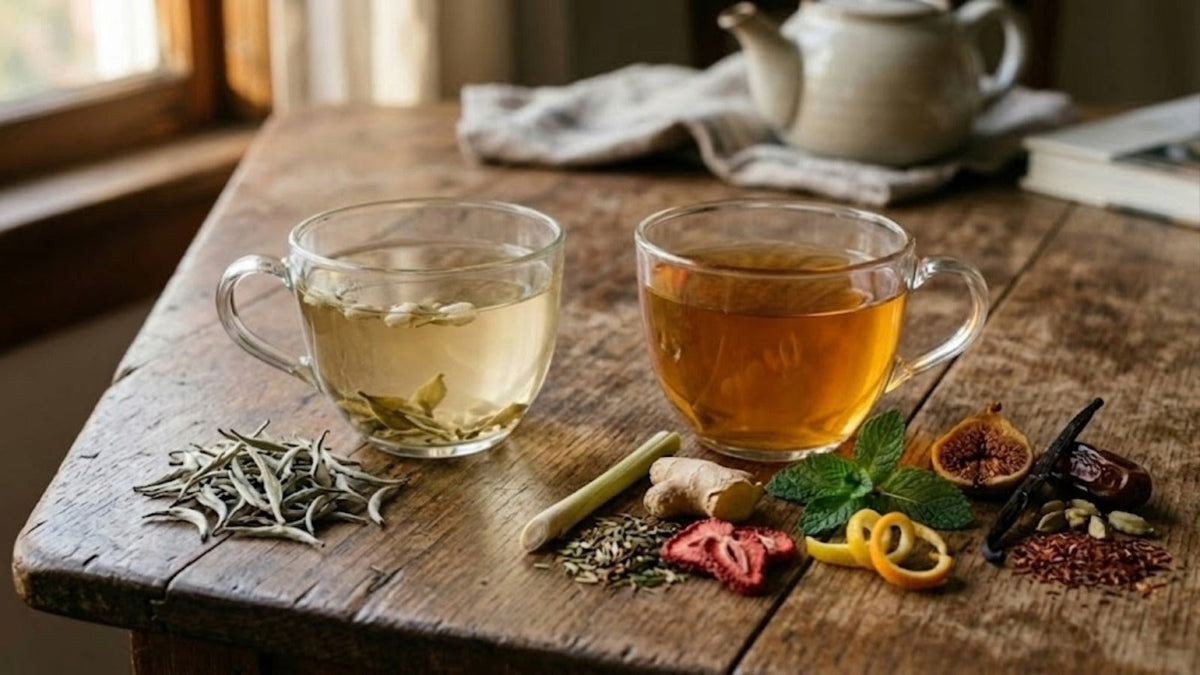
Herbal Tea vs Oolong Tea: Key Differences

Oolong tea is true tea, made from Camellia sinensis, the same plant as green, black, and white. What makes oolong unique is where it sits between them. Green tea is barely oxidized and black tea is fully oxidized, and oolong is the entire middle of that range: not a third fixed point, but the whole span from lightly oxidized and close to green, to heavily oxidized and close to black. So oolong is not one tea with one taste. It is a spectrum. Herbal tea is a different category altogether, brewed from the flowers, fruits, roots, and leaves of other plants, and, with rare exceptions, it carries no caffeine at all.
That is where the two part ways for anyone deciding what to pour. Every oolong, light or dark, carries caffeine, because every oolong is still the tea plant, so it keeps daytime hours the way green and black do. Herbal tea has no such limit. It is the cup with no cutoff, the one that can carry you from morning all the way to the last hour before bed, and that is the difference worth holding onto. For the broader botanical distinction behind this comparison, start with Herbal Tea vs Tea: Why They're Not the Same Plant.
Herbal Tea vs Oolong Tea: What Is the Difference?
| Feature | Herbal tea | Oolong tea |
|---|---|---|
| Plant source | Flowers, roots, bark, fruit, and leaves of many plants | Leaves of Camellia sinensis |
| Caffeine | None, aside from trace amounts in botanicals like cacao | Yes, moderate |
| Brewing | 205°F, 5 to 7 minutes, or longer | 195°F, short steeps, re-steeps many times |
| Flavor | Anything from tart hibiscus to sweet fig, depending on the botanical | Floral and light to dark and roasted, by oxidation |
| Known for | Varies entirely by botanical | Partial oxidation |
| Best time of day | Any hour, morning to night | Morning through afternoon |
Herbal Tea vs Oolong Tea: Phases of the Day
Oolong covers more of the day than most true teas, but it still stops where they all do. Because it ranges from light and floral to dark and roasted, there is an oolong for the fresh part of the morning and a heavier one for the middle of the afternoon, which gives it more reach across the daylight hours than a single green or black tea has. What it cannot do is cross into the evening. Every oolong, however light, is still the tea plant, and still carries enough caffeine to sit with you past bedtime if you drink it too late. Herbal tea is the one category that does not answer to that. With no caffeine anywhere in the pot, it has no wall to hit, which is why it is the cup you can still reach for when the day is done.

Herbal tea works by a different logic, and it is worth learning. Instead of one plant with one window, it offers a different botanical for each stretch of the day: something lively and fruit-bright first thing, something clean and cooling when the afternoon drags, something warm and almost sweet once the lights go low. Read it that way and the long list of unfamiliar herbs turns into something much simpler, a handful of cups sorted by when they belong. You are not memorizing plants. You are letting the time of day choose for you.
Herbal Tea vs Oolong Tea: Caffeine
A cup of oolong runs about 38 milligrams of caffeine, with most cups landing somewhere in the 30 to 50 range. That puts it squarely between green tea, which is a little lower, and black tea, which is higher, and well under coffee, which is roughly double. Oolong is the moderate middle of the true teas, a real lift without the edge coffee can bring. The interesting part is that how you brew it moves the number more than which oolong you chose: hotter water, a longer steep, and more leaf all pull more caffeine, so the same tea can give you a gentle cup or a strong one depending on your hand.
Herbal tea takes all of that off the table. With no tea leaf in the pot, there is no caffeine to brew weak or strong, no steep time to watch for the sake of staying calm later. An herbal cup is the same zero at midnight as it is at noon. That is the line that matters when you are deciding what to drink and when: oolong asks you to think about the hour and the pour, and herbal tea asks you to think about neither.
Herbal Tea vs Oolong Tea: Flavor Profile
Oolong has the widest flavor range of any tea, and the reason is oxidation. Green tea is barely oxidized and black tea is fully oxidized, but oolong lives in the whole middle, anywhere from around 10 percent to 80 percent, and the tea maker chooses where on that dial to stop. Turn the dial low and you get a tea like Tieguanyin: floral and orchid-like, buttery, almost creamy, closer to green tea than to black. Turn it high and roast the leaves hard and you get a tea like Da Hong Pao, a Wuyi rock oolong that is dark, mineral, and toasty, with notes of cocoa and a long roasted finish that sits closer to coffee than to a flower. Those two cups taste almost nothing alike, and both are oolong. It is less a single flavor than a spectrum you move along.
![[new alt]](https://cdn.shopify.com/s/files/1/0692/2901/9190/files/Herbal_Tea_vs_Oolong_Tea_Key_Differences_8a9e84d0-f61e-41cd-b9a1-883a40f2ee2e.jpg?v=1785274397)
Herbal tea has huge range too, but it is a different kind of range, and the difference is the whole point. Oolong's spectrum is one plant moved along a single dial: however far apart a light and a dark oolong taste, they are the same leaf, points on one continuous line. Herbal tea has no line. Its range is not a dial but a room full of unrelated plants: hibiscus tart and cranberry-sharp, chamomile soft and apple-like, peppermint cool and clean, fig round and almost caramelized, none of them related to the others by anything but the pot. Oolong gives you range within one thing. Herbal tea gives you range across many. With oolong you are choosing where on the dial you want to be. With herbal tea you are choosing which plant entirely.
What Is in Herbal Tea?
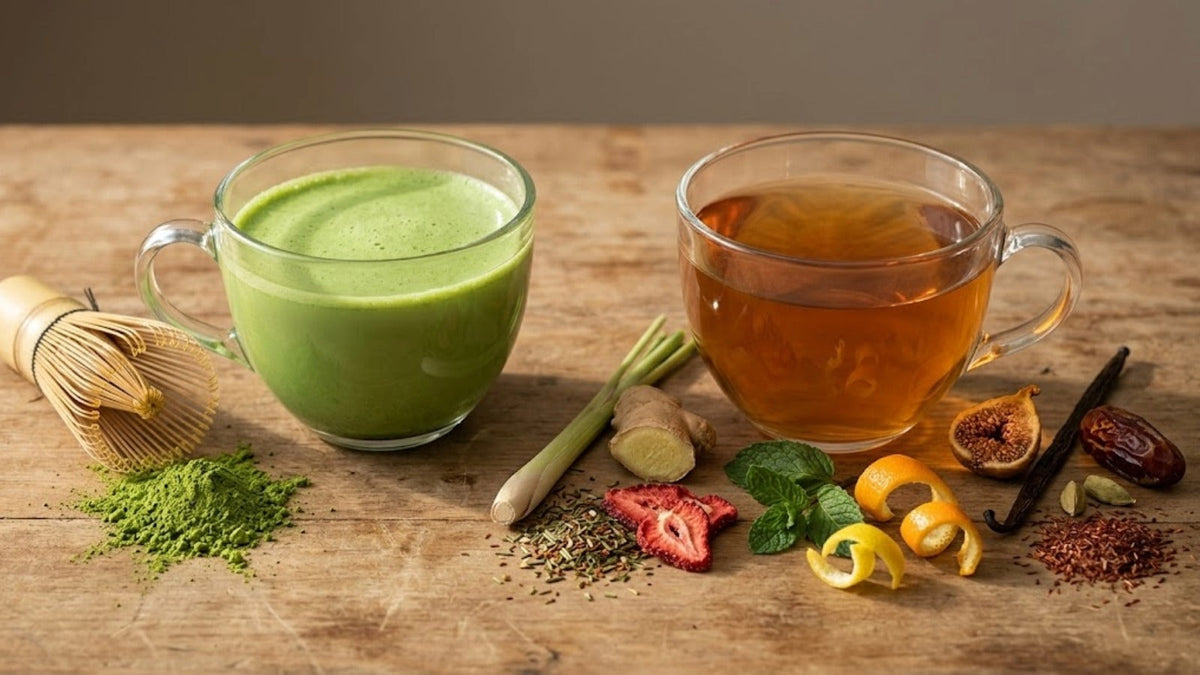
Oolong gets its range from one plant and one dial. Herbal tea gets its range from having no single plant at all, and that is where people tend to misread it, because the first thing they picture is fruit. Fruit is rarely what defines the cup. Lemongrass, ginger, and green rooibos wake a morning blend up, bright and clean, before a single berry is added. Spearmint and lemon verbena keep a midday cup cool and clear on their own. Chamomile, lavender, and red rooibos settle an evening blend into something soft and slow with nothing else in the pot. Brew any one of them alone and you can still name the hour it belongs to. The botanical sets that. The fruit has not arrived yet.

So fruit is the top layer, not the base, and any tea can carry it. What a good blend does is match that layer to the hour it is built for. Mornings want brightness, so fruit belongs there, which is why a well-made morning cup tastes fruit-forward and why most people assume fruit is the whole story. Middays want a reset, so cool mint plays against warm spice. Evenings want dessert, so red rooibos, honeybush, vanilla, fig, and date carry the cup, sweet and round without a grain of sugar. That is what the fruit-first idea misses: the blend is put together for the time of day you reach for it.
Herbal Tea vs Oolong Tea: How to Brew Them
Oolong is built to be brewed more than once. Many oolongs are rolled into tight little pellets, and they open slowly, so a single measure of leaves gives you not one cup but a series of them, five or more from good leaf, each one different. The tightly rolled ball unfurls a little further with every steep, and the flavor travels as it goes: the early infusions are the most aromatic and sweet, the middle ones fullest, the later ones softer and more mineral. Brew it around 195°F, start with short steeps, and add a little time to each one as the leaves open. Steeping oolong once and throwing the leaves away leaves most of the tea in the pot, unopened.
![[new alt]](https://cdn.shopify.com/s/files/1/0692/2901/9190/files/Herbal_Tea_vs_Oolong_Tea_How_to_Brew_Them.jpg?v=1785274508)
Herbal tea works the other way, and it is simpler for it. Most blends give their full character in a single pour, because there is nothing held in reserve: the flowers, fruit, and leaves have already opened, so one long steep in fully boiling water pulls everything they have. A few, rooibos among them, are happy to go a second round, but the point of an herbal cup is not the session. It is the one pour, made once and left alone. Oolong asks you to sit with it and follow where it goes across a handful of steeps. Herbal tea asks for nothing but the wait, which is its own kind of ease, especially at the end of a day when a tea ceremony is the last thing you want.
Herbal Tea vs Oolong Tea: Which is Healthier?
Oolong sits between green and black tea in its makeup, the same way it does in flavor and caffeine. Because it is partially oxidized, it carries some of both sides: the catechins that green tea is known for, including EGCG, alongside the theaflavins that form when a leaf oxidizes toward black, plus a measure of L-theanine. It is also the tea most tied to weight and metabolism in the popular imagination, the reason it had a moment as a diet drink, though the research behind that reputation is more mixed than the marketing ever was. Healthline lays out what the studies actually show in its overview of oolong's benefits.
![[new alt]](https://cdn.shopify.com/s/files/1/0692/2901/9190/files/Herbal_Tea_vs_Oolong_Tea_Which_is_Healthier.jpg?v=1785274622)
Herbal tea cannot be lined up the same way, and that is where the comparison quietly falls apart. There is no single herbal profile, because there is no single herbal plant. Chamomile, hibiscus, ginger, and peppermint have nothing in common but the absence of the tea leaf, so what any herbal cup offers depends entirely on which plant is in the pot. That is why "which is healthier" is the wrong question to ask. You can weigh oolong against chamomile, or oolong against ginger, but not oolong against a whole category at once. For the plant-by-plant picture, WebMD's guide to herbal teas is a good place to start.
Herbal Tea vs Oolong Tea: Which Should You Drink?
The choice comes down to the clock, and oolong covers a good stretch of it. Because it runs from light and floral to dark and roasted, there is an oolong for the fresh part of the morning and a heavier one for the slow part of the afternoon, which gives it more range across the daylight hours than most single teas. What it cannot do is cross into the evening, because every oolong, light or dark, is still the tea plant and still carries caffeine. Herbal tea is the one with no such wall. Neither is the better tea. They were built for different parts of the day, and the useful question was never which one wins.
It is which hour you are in. Reach for oolong when you want a tea with somewhere to go, a cup worth sitting with while the day is still bright. Reach for herbal tea when you want one that follows the whole arc of it, morning through the last hour before bed, changing character as the day does. That is the idea behind the Purely daily ritual: not one tea for every moment, but the right cup for the hour you are in. For the broader foundation behind that approach, explore our guide to what herbal tea is, how it works, and when to drink it.
References
- Healthline. Oolong Tea Benefits: Nutrition, Heart Health, and More.
- WebMD. Oolong Tea: Uses, Side Effects, and More.
- WebMD. Gallery of Herbal Teas: Types and Benefits of Herbal Teas.
Editorial Disclaimer
This content is for informational and educational purposes only. It reflects general perspectives on herbal tea, daily rituals, and related lifestyle practices. It is not intended to provide medical advice, diagnose conditions, or recommend treatments. Always consult a qualified healthcare professional with any questions about wellness or health-related matters.