Herbal Tea vs White Tea: Key Differences

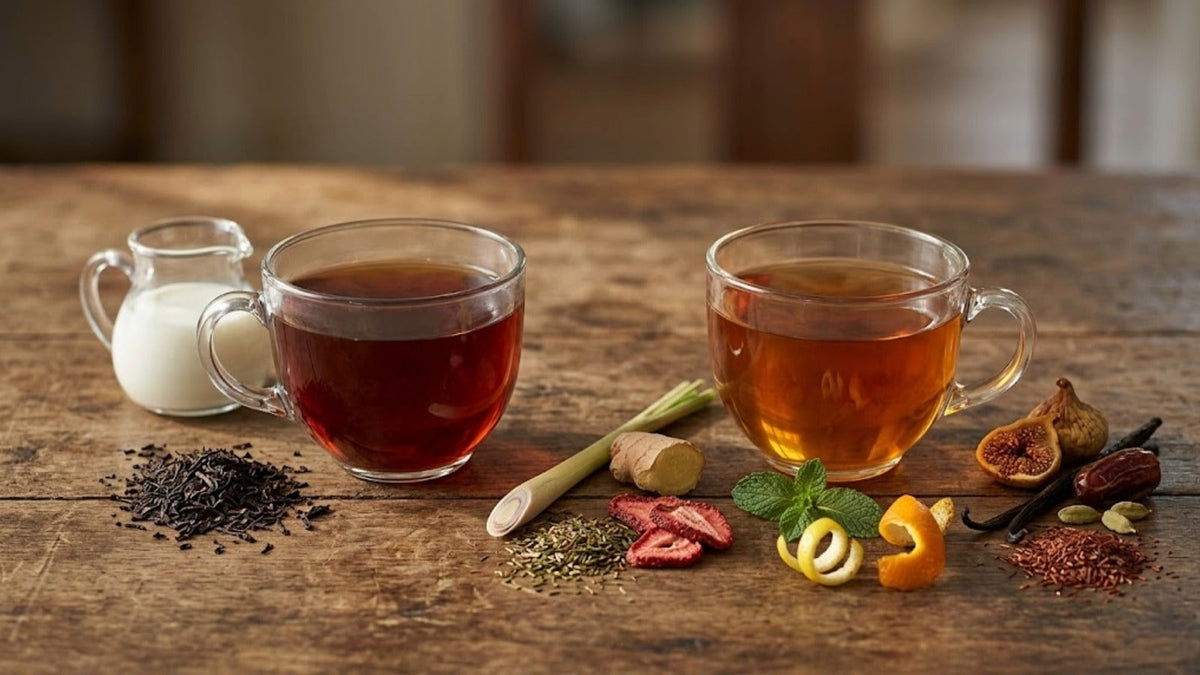
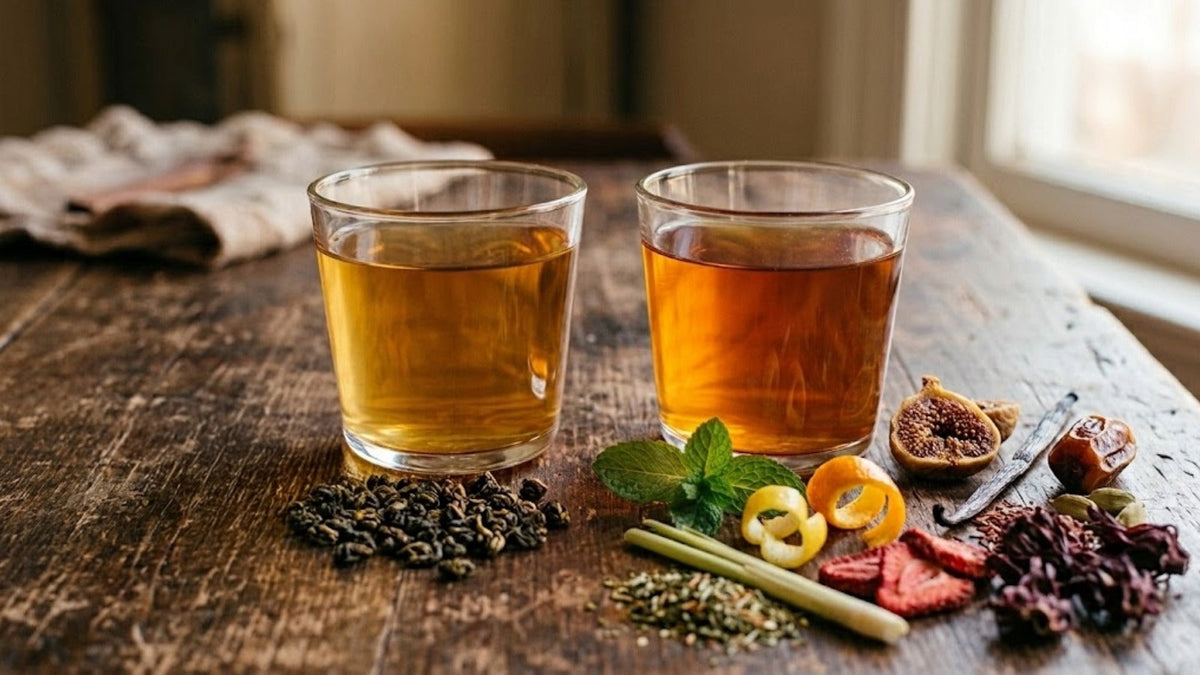
White tea is true tea. It comes from Camellia sinensis, the same plant as green, black, and oolong, and it carries caffeine like all of them. People ask whether it is herbal for two understandable reasons. It is pale and delicate, closer in the cup to a light infusion than to a bracing black tea, and it is often sold blended with herbs and fruit, White Peach or Rose White, stacked on the same shelf as the tisanes. Even the plain kind wears a flower's name: White Peony is one of the most common white teas, and there is not a petal of peony in it, only young tea leaves. But the name is poetry, not botany. White tea grows on the tea bush. Herbal tea is drawn from everything else that grows: the flowers, fruits, roots, and leaves of countless other plants.
The delicacy fools people twice. Because white tea looks and tastes light, it gets treated like an evening cup, something you could sip before bed the way you would a chamomile. It cannot do that job. No matter how pale it looks, it still carries caffeine, more than its color suggests, so it keeps the same daytime hours the other true teas do. Herbal tea has no such limit, which is the difference worth holding onto: white tea is a delicate daytime cup, and herbal tea is the one that goes all the way to bedtime. For the broader botanical distinction behind this comparison, start with Herbal Tea vs Tea: Why They're Not the Same Plant.
Herbal Tea vs White Tea: What Is the Difference?
| Feature | Herbal tea | White tea |
|---|---|---|
| Plant source | Flowers, roots, bark, fruit, and leaves of many plants | Young buds and leaves of Camellia sinensis |
| Caffeine | None, aside from trace amounts in botanicals like cacao | Yes, low to high |
| Brewing | 205°F, 5 to 7 minutes, or longer | 170 to 185°F, 1 to 3 minutes, gently |
| Flavor | Anything from tart hibiscus to sweet fig, depending on the botanical | Delicate and mellow, with notes of hay and melon |
| Known for | Varies entirely by botanical | Minimal processing |
| Best time of day | Any hour, morning to night | Daytime, not evening |
Herbal Tea vs White Tea: Phases of the Day
White tea invites a reasonable mistake. It is the palest true tea, the mildest, the one that looks and tastes closest to a gentle evening cup, so people assume it must be nearly caffeine-free, the true tea you can drink late. It is not. White tea carries caffeine like every leaf from the tea plant, and often more than its color would ever suggest, which means the most delicate-looking cup in the cabinet keeps the same daytime hours as the boldest black tea. You cannot read a true tea's caffeine off how light it looks. Herbal tea is the one place where light really does mean caffeine-free, and that is what lets it go where white tea cannot follow.

This is where herbal tea does something no true tea can. Sort it by the clock instead of by the plant and it falls into place: something bright and fruit-led to open the morning, something cool and clean through the middle of the day, something round and dessert-like to close the night. You are not studying a shelf of unfamiliar botanicals. You are matching a cup to an hour, and there is a cup for every hour. That is the whole idea, and it is why herbal tea reaches the parts of the day white tea has to leave alone.
Herbal Tea vs White Tea: Caffeine
White tea carries anywhere from 6 to 55 milligrams of caffeine a cup, a wider swing than green or black tea, which sit in tighter, higher bands. On average it runs about 15% below green tea, so it is usually the gentler true tea, but "usually" is the operative word. How much you actually get is largely in your hands: hotter water and a longer steep pull more caffeine, cooler water and a short steep pull much less. The same leaves can give you a barely-there cup or a genuine lift depending on how you brew them. What they will not give you is zero. However pale it pours, white tea is a caffeinated drink, which is the thing its delicacy hides.
Herbal tea removes the variable entirely. With no leaf from the tea plant in the pot, there is no caffeine to extract no matter how hot the water or how long it sits, so an herbal cup at ten at night is exactly as caffeine-free as one at ten in the morning. That is the practical line between them. White tea asks you to think about when and how you brew it. Herbal tea asks nothing, which is why it is the one you can reach for without checking the clock.
Herbal Tea vs White Tea: Flavor Profile
White tea tastes the way it does because almost nothing is done to it. Green tea is heated to arrest the leaf and lock in its grassy freshness; black tea is fully oxidized into something dark and malty. White tea is neither cooked nor transformed. The buds are picked, left to wither, and dried, and that is close to the whole of it, which is why the cup tastes nearer to the raw leaf than any other tea does. The flavor is faint on purpose: honey and fresh hay, a note of melon, a soft floral edge, all of it quiet, none of it sharp. There is almost no bitterness and no bite, just a clean sweetness that asks you to slow down to catch it. The two grades you will meet are Silver Needle, made of buds alone and the most delicate of all, and White Peony, which adds the first young leaves for a fuller, slightly stone-fruit-leaning cup.
![[new alt]](https://cdn.shopify.com/s/files/1/0692/2901/9190/files/Herbal_Tea_vs_White_Tea_Flavor_Profile.jpg?v=1785123846)
Herbal tea moves in the opposite direction. White tea is one quiet note held very still; herbal tea is the full range, loud where it wants to be. Nothing links a hibiscus to a chamomile to a fig except that none of them is the tea plant, so the flavors swing from tart to floral to sweet with no common center. That is not a knock on either one. White tea offers subtlety, a single delicate thing done perfectly. Herbal tea offers range, a different cup for a different mood. With white tea you are tasting the leaf at its most untouched. With herbal tea you are choosing which plant, of hundreds, you want in front of you.
What Herbal Tea Is Made From
White tea is one plant left nearly alone. Herbal tea is the reverse: many plants, each brought in for something different, which is exactly why the category is so wide and so easy to misread. Most people picture fruit tea when they hear herbal, but fruit is seldom what defines the cup. Lemongrass, ginger, and green rooibos give a morning blend its bright, clean lift before any berry joins them. Spearmint and lemon verbena hold a midday cup cool and clear on their own. Chamomile, lavender, and red rooibos turn an evening blend soft and slow with nothing else added. Brew any of them by itself and you can still name the hour it belongs to. The botanical decides that. The fruit has not arrived yet.

So fruit is the finish, not the foundation, and any tea can wear it. What a well-built blend does is fit the fruit to the hour it is meant for. Mornings want brightness, so fruit sits naturally there, which is why a good morning cup tastes fruit-forward and why so many people assume fruit is all herbal tea ever is. Midday wants a reset, so cool mint leans against warm spice. Evenings want dessert, so red rooibos, honeybush, vanilla, fig, and date do the work, sweet and rounded without a spoonful of sugar. That is what the fruit-first assumption misses: the blend is designed around the time you will drink it.
Herbal Tea vs White Tea: How to Brew Them
White tea has a reputation for being fussy, and it mostly is not deserved. The old advice is to treat it like green tea, cool water only, or you will scorch it. In practice white tea is hard to ruin: it rarely turns bitter, it re-steeps two or three times, and it takes a wide range of temperatures without complaint. What temperature does change is character. Brew it cool, around 170°F, for a short steep and you get the delicate, honeyed cup white tea is famous for. Brew it hot, near boiling, and let it sit, and the same leaves give a fuller, bolder cup. Neither is wrong. White tea is the rare true tea that invites you to experiment, because the leaves forgive the mistakes you make while you learn what you like.
![[new alt]](https://cdn.shopify.com/s/files/1/0692/2901/9190/files/Herbal_Tea_vs_White_Tea_How_to_Brew_Them.jpg?v=1785124370)
Herbal tea is forgiving in a simpler way. There is no delicate-versus-bold dial to turn, no window to hit: full boiling water, a long steep, five to seven minutes or more, and it only grows deeper rather than sharp, because there is no tea leaf in the pot to over-extract. Steep it covered so the aromatic oils stay in the water instead of leaving with the steam, and steep it as long as you like. Both teas are easy to make well, which is worth saying, since so much tea writing turns brewing into a test. The difference is only in what they ask of you. White tea rewards attention if you want to give it. Herbal tea is happy to be forgotten on the counter for ten minutes and still be exactly right.
Herbal Tea vs White Tea: Which is Healthier?
White tea is the least studied of the true teas, and that is a fact about its popularity, not its quality. Because it is the least processed, it holds onto a high level of the catechins and polyphenols that researchers look for, on par with green tea by most counts. What it lacks is attention: white tea is rarer and less commonly drunk, so far less research has been done on it than on green or black. The compounds are there; the studies mostly are not yet. Healthline gathers what does exist in its overview of white tea's benefits, hedges and all.
![[new alt]](https://cdn.shopify.com/s/files/1/0692/2901/9190/files/Herbal_Tea_vs_White_Tea_Which_is_Healthier.jpg?v=1785124195)
Herbal tea cannot be pinned down the same way, which is where the comparison stops making sense. There is no single herbal profile because there is no single herbal plant. Chamomile, hibiscus, ginger, and peppermint share nothing but the absence of the tea leaf, so what any herbal cup offers depends entirely on which plant is in the pot. That is why "which is healthier" is the wrong question. You can set white tea against chamomile, or white tea against ginger, but not white tea against an entire category. For the plant-by-plant picture, WebMD's guide to herbal teas is a good place to start.
Herbal Tea vs White Tea: Which Should You Drink?
The choice comes down to the clock, though white tea makes it easy to guess wrong. It is the palest, most delicate true tea, so it reads like an evening cup, but it carries caffeine like any leaf from the tea plant and keeps daytime hours despite its softness. Drink it in the morning or the quiet part of the afternoon, when you want something gentle that is still real tea. Herbal tea is the one with no cutoff at all, a category wide enough to open the morning and close the night. Neither is the better tea. They were built for different stretches of the day, and the question was never which one wins.
It is which hour you are in. Reach for white tea when you want a delicate cup and the day is still going. Reach for herbal tea when you want one that follows the whole arc of it, bright to cooling to dessert, right up to bedtime. That is the idea behind the Purely daily ritual: not one tea for every moment, but the right cup for the hour you are in. For the broader foundation behind that approach, explore our guide to what herbal tea is, how it works, and when to drink it.
References
- Healthline. How Much Caffeine Is in White Tea?.
- Healthline. 10 Impressive Benefits of White Tea.
- WebMD. Gallery of Herbal Teas: Types and Benefits of Herbal Teas.
Editorial Disclaimer
This content is for informational and educational purposes only. It reflects general perspectives on herbal tea, daily rituals, and related lifestyle practices. It is not intended to provide medical advice, diagnose conditions, or recommend treatments. Always consult a qualified healthcare professional with any questions about wellness or health-related matters.