Herbal Tea vs Decaf Tea: Key Differences

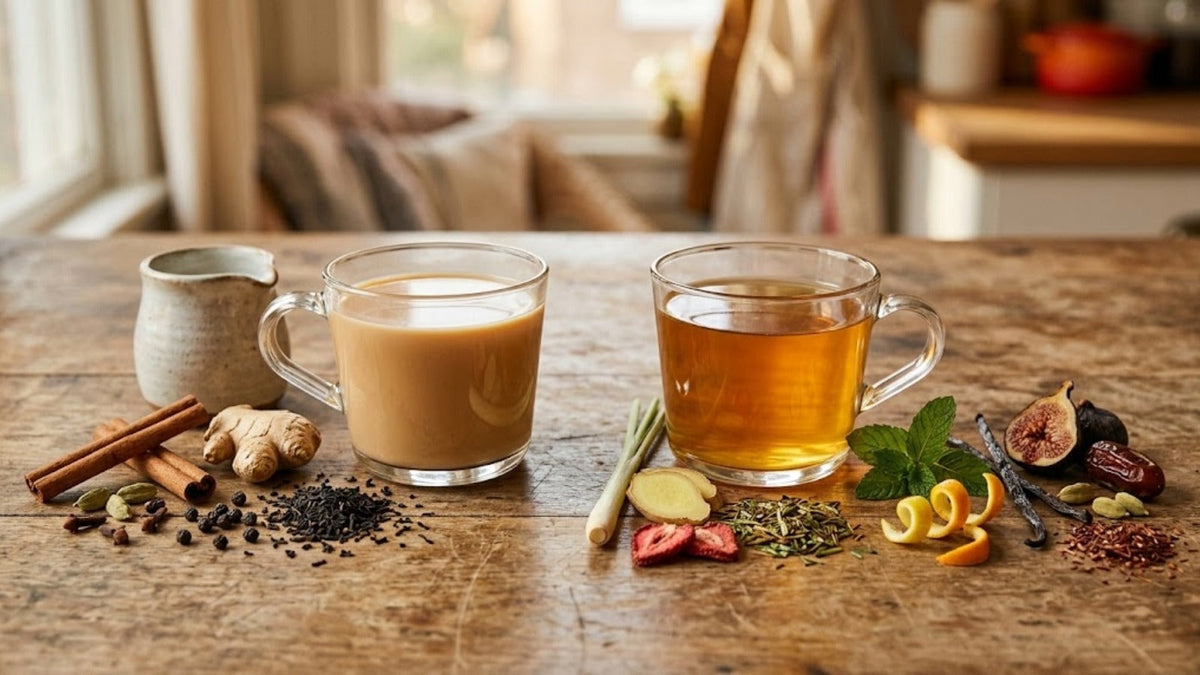
Decaf tea and herbal tea are easy to lump together, since both are the low-caffeine cups you reach for when you don't want a jolt. But they get there in opposite ways. Decaf is true tea, the caffeinated leaf of Camellia sinensis, usually black or green, that has had most of its caffeine stripped out by a decaffeination process. Herbal tea never had caffeine to begin with. It is made from plants that do not produce it at all, the flowers, fruits, roots, and leaves that fill a tisane. So decaf arrives at low caffeine by subtraction, something taken out of a leaf that had it. Herbal tea arrives there by nature, a cup that never contained caffeine in the first place.
That difference sounds academic until you look closely at the word "decaf." Because decaf is caffeine removed rather than caffeine absent, the removal is never total: a decaf cup still carries a small amount of caffeine, a few milligrams left behind by a process that gets most but not all. Herbal tea essentially carries none, because there was never any there to leave behind. For a casual cup the gap is small. But if what you want is genuinely zero caffeine, the honest answer is that decaf is very low and herbal tea is actually none, and that is the difference this comparison turns on, not when you drink them, since both suit the same quiet hours, but whether almost none and none are the same thing to you. For the broader botanical distinction behind this comparison, start with Herbal Tea vs Tea: Why They're Not the Same Plant.
Herbal Tea vs Decaf Tea: What Is the Difference?
| Feature | Herbal tea | Decaf tea |
|---|---|---|
| Plant source | Flowers, roots, bark, fruit, and leaves of many plants | Black or green tea (Camellia sinensis), decaffeinated |
| Caffeine | None, aside from trace amounts in botanicals like cacao | Low, but not zero (about 1 to 8 mg) |
| Brewing | 205°F, 5 to 7 minutes, or longer | Follows its base tea, black or green |
| Flavor | Anything from tart hibiscus to sweet fig, depending on the botanical | Milder than its base tea |
| Known for | Varies entirely by botanical | Caffeine removed by processing |
| Best time of day | Any hour, morning to night | Any hour |
Herbal Tea vs Decaf Tea: Caffeine
Here is the fact the word "decaf" hides: decaffeinated tea is not caffeine-free. The FDA notes plainly that decaffeinated coffees and teas still contain some caffeine. Decaffeination strips most of it from the leaf, usually well over ninety percent, but never the last trace, leaving a few milligrams in a cup against the forty or fifty in regular black tea. Steep it longer and you pull a little more of what remains. It is a large reduction, enough that most people feel nothing from it. But reduced is not removed. Decaf names a process, not a result, and the process leaves a trace behind.
Herbal tea has no trace, because it had nothing to remove. The plants an herbal cup is brewed from never made caffeine, so there is no process, no residue, no "almost." Zero is the starting point, not a target the leaf is processed toward. For a casual evening cup, the gap between decaf's few milligrams and herbal tea's none is small enough to ignore. But the people who go looking for this comparison often are not casual about it. If you are avoiding caffeine for sensitivity, during pregnancy, or simply because you do not want to gamble a night's sleep on a few milligrams, "very low" and "none" stop being the same answer. Decaf gets you close. Herbal tea is the only one of the two that can honestly say zero.
Herbal Tea vs Decaf Tea: A Process, or a Plant
The reason decaf keeps a trace of caffeine comes down to how it is made. Caffeine is bound up inside the tea leaf, and getting it out takes a decaffeination process, one of several. Some methods use only water or pressurized carbon dioxide; others use a chemical solvent to draw the caffeine off the leaf. All of them are regulated, and all of them remove most of the caffeine while leaving the leaf otherwise intact, or close to it. The method matters enough that some drinkers seek out water-processed decaf specifically, preferring to avoid the solvent-based kinds. Either way, the point holds: decaf is tea that something was done to. It started as a caffeinated leaf and was processed into a milder one.

Herbal tea skips the entire question. There is no caffeine bound up in chamomile or rooibos or peppermint, so there is nothing to extract, no method to choose, no solvent to weigh, no process at all. The plants are dried and blended, and that is the whole of it. This is the quiet advantage of a cup that was never caffeinated to begin with: it arrives caffeine-free without anything being done to it, where decaf has to be processed toward the same place and still does not fully arrive. One is a plant. The other is a process applied to a plant.
Herbal Tea vs Decaf Tea: Flavor Profile
Decaf tastes like the tea it came from, with the depth turned down. The decaffeination process does not remove only caffeine; it takes some of the flavor with it, pulling out a share of the tannins and aromatic compounds that give tea its body and grip. So decaf black tea reads as a lighter, softer version of black tea, recognizably the same cup but with less of the malty backbone and brisk edge that black tea drinkers reach for. This is the quiet tradeoff of decaf, and it is why people who switch often say it is close but not quite the same. Nothing was added to make up the difference, because the process is a subtraction, and a little of the character leaves with the caffeine.

Here is what most comparisons miss: the naturally caffeine-free cup does not have to be thin. People picture chamomile and peppermint, delicate and light, and assume that is the whole of it, but herbal tea has real body when you know where to look. Rooibos and honeybush are woody, round, and naturally sweet, with enough weight to stand up to milk. Roasted chicory and dandelion root go darker still, deep and almost coffee-like. For someone who misses the body of black tea, these give it back, and they never surrendered anything to a process to get there. The choice was never thin decaf or wispy chamomile. It is a tea that gave up some of itself to lose its caffeine, or a plant that had body of its own and never contained caffeine to begin with.
What Goes Into Herbal Tea
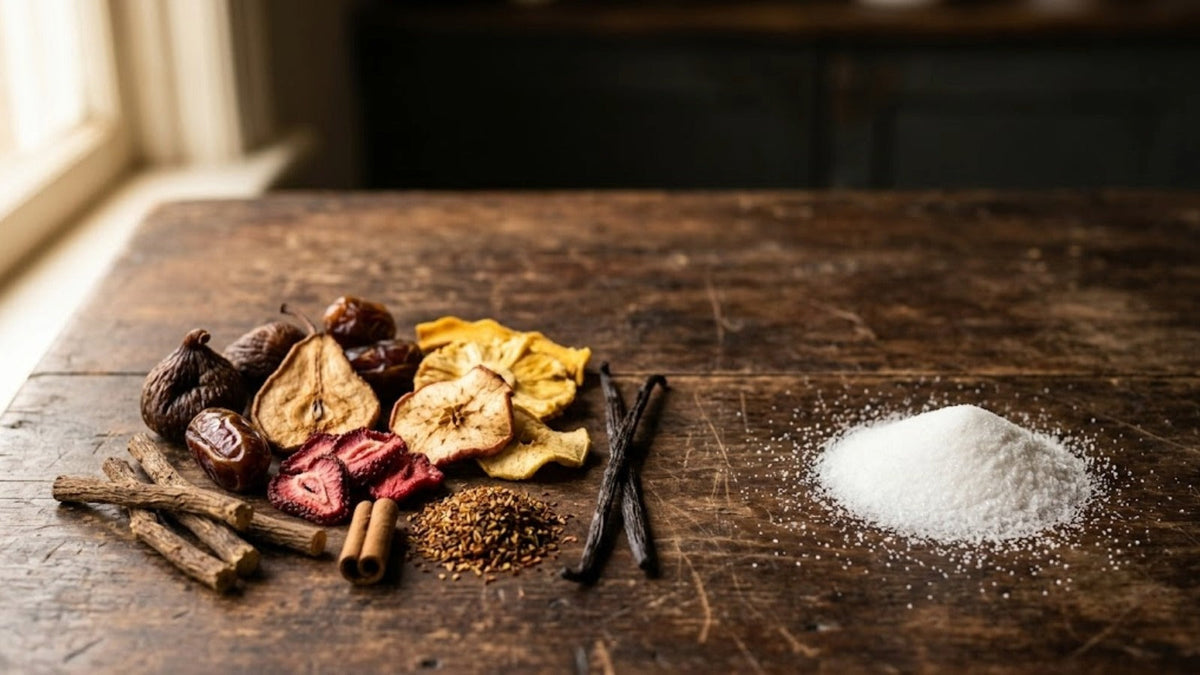
If decaf makes people picture a narrow, watered-down cup, herbal tea is the opposite: one of the widest categories in the drink. It is not one plant or one kind of plant. It is flowers like chamomile, hibiscus, and lavender; fruits like apple, fig, and berry; leaves like mint and lemongrass; and roots and barks like ginger, rooibos, chicory, and licorice. Nearly every part of nearly every kind of plant turns up somewhere in it. That breadth is why herbal tea runs the whole way from feather-light to genuinely full-bodied, delicate floral infusions at one end and dark, malty, root-heavy cups at the other. Caffeine-free was never the same as limited.

And every plant in that range shares one thing: none of it ever contained caffeine. The whole pantry is caffeine-free by nature, not by processing, which means the breadth is not just variety for its own sake. Whatever you are after, a light cup or a deep one, something bright or something that stands in for a strong evening tea, there is a naturally caffeine-free plant that does it, with no leaf that had to be stripped to get there. That is the difference that runs under this entire comparison. Decaf reaches caffeine-free by taking something out. Herbal tea was there all along.
Herbal Tea vs Decaf Tea: How to Brew Them
Decaf brews like the tea it started as, which means it keeps that tea's demands. Decaffeination takes the caffeine, not the fussiness. A decaf green still scorches if you pour boiling water over it, turning sharp and bitter the same way full-caffeine green does, so it still wants water off the boil and a short steep. A decaf black still turns astringent if you leave it past a few minutes. You brew it with the same care the original asked for, watching the temperature and the clock, and at the end of all that attention you have a cup with a little less to give than the leaf it came from.

Herbal tea asks for none of that care, and holds nothing back in return. There is no tea leaf in it to scorch or over-steep, so you pour water at a full boil, leave it five to seven minutes or longer, and walk away without a thought for the timer. It will not turn bitter for being forgotten. That ease comes from the same place its caffeine-free-ness does: it was never the tea plant, so it never inherited the tea plant's rules. Decaf carries all of true tea's brewing demands without the caffeine that was the point of them. Herbal tea carries none of them, and simply steeps.
Herbal Tea vs Decaf Tea: Which is Healthier?
People often assume decaf tea is just regular tea with the caffeine gone, the same benefits minus the buzz. It is not quite that clean. The same process that pulls out caffeine tends to take some of the tea's antioxidants with it, the catechins and polyphenols the leaf is studied for, because they wash out alongside the caffeine. How much depends on the method, with the water and carbon dioxide processes generally holding onto more than the solvent ones. Estimates vary widely from one study to the next, but the direction is consistent: a decaf cup carries somewhat less of what made the original leaf interesting to researchers. It is still tea, still has something in it, just a little less of it than before it was processed.

Herbal tea sits outside this question entirely, the same way it sat outside the caffeine one. There is no single herbal profile to weigh against decaf, because there is no single herbal plant: chamomile, rooibos, hibiscus, and ginger each bring something different, and what any herbal cup offers depends on which plant is in it. So "which is healthier" is the wrong question here, as it was with every true tea. You can compare decaf tea to a specific herb, but not to the whole category at once. For a plant-by-plant sense of what different botanicals offer, WebMD's guide to herbal teas is a good starting point.
Herbal Tea vs Decaf Tea: Which Should You Drink?
The choice comes down to how you want to arrive at low caffeine, because that is the one real difference between them. Decaf is true tea, black or green, that had its caffeine taken out by a process, and the process is never perfect: a little caffeine stays, a little flavor and antioxidant goes, and the leaf ends up a milder version of what it was. If what you want is the taste of real tea with most of the caffeine gone, decaf is the closer match, and it is a fair trade for a lot of people. Herbal tea reaches low caffeine from the other side entirely, by never having any. Neither is the better drink. They just get to nearly the same place by opposite routes, and the useful question was never which one wins.
It is which route fits you. Reach for decaf when you specifically want the flavor of black or green tea and are content that "mostly decaffeinated" is close enough. Reach for herbal tea when you want a cup that is caffeine-free by nature rather than by processing, that was never stripped of anything, and that can honestly promise zero when zero is what you need. That is the idea behind the Purely daily ritual: not tea with something removed, but plants that were caffeine-free from the start, made to be enjoyed at any hour you like. For the broader foundation behind that approach, explore our guide to what herbal tea is, how it works, and when to drink it.
References
- U.S. Food and Drug Administration. Spilling the Beans: How Much Caffeine is Too Much?.
- WebMD. Gallery of Herbal Teas: Types and Benefits of Herbal Teas.
- Henning, S.M., et al. "Catechin Content of 18 Teas and a Green Tea Extract Supplement Correlates With the Antioxidant Capacity." Nutrition and Cancer, 2003.
Editorial Disclaimer
This content is for informational and educational purposes only. It reflects general perspectives on herbal tea, daily rituals, and related lifestyle practices. It is not intended to provide medical advice, diagnose conditions, or recommend treatments. Always consult a qualified healthcare professional with any questions about wellness or health-related matters.