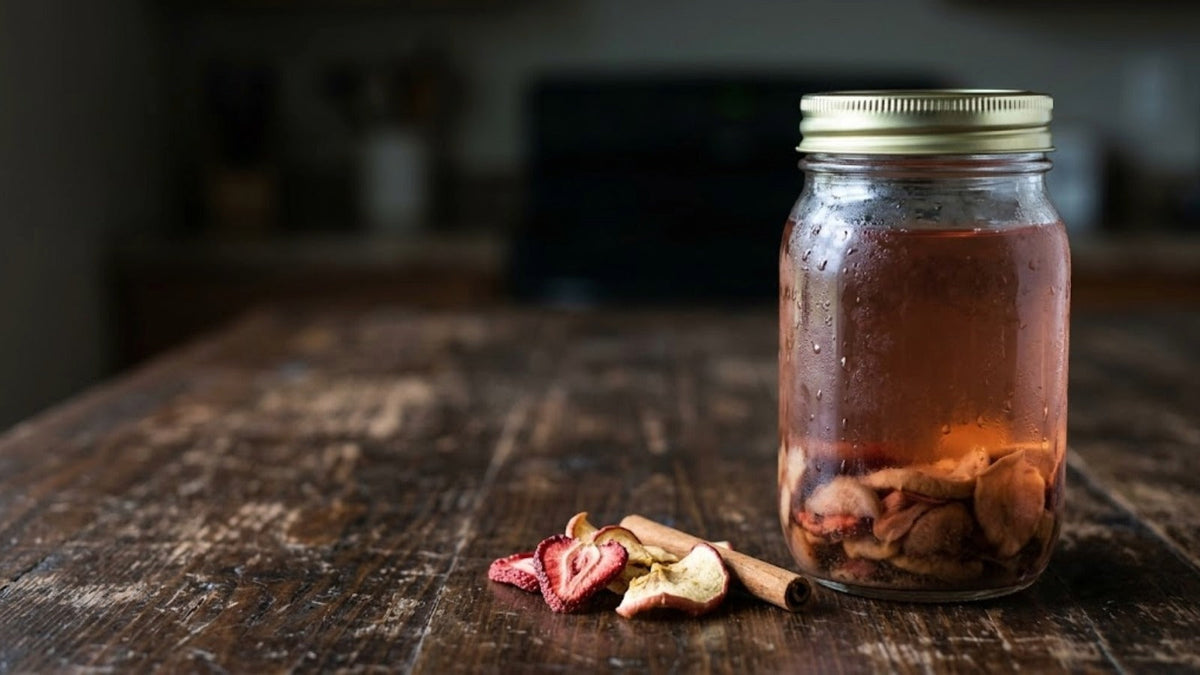
How to Make Herbal Tea Sweeter Without Sugar

Before you reach for the table sugar, try steeping your tea in the water longer and using more of it. Regular tea, the black or green kind, turns bitter if you leave the bag in too long, so most people take herbal tea out early out of habit. Herbal tea is made from different plants entirely, flowers and fruit and roots rather than tea leaves, and none of them turn bitter on you. Ten minutes is fine. So is twenty. That alone rescues a lot of weak cups. What it will not fix is a blend that never had much sweet in it, and that is the more common problem, because the front of the bag says strawberry and the drink still taste sour. For the broader basics behind brewing herbal tea differently, start with Herbal Tea for Beginners: Why the Usual Tea Rules Do Not Apply.
Why Your Herbal Tea Tastes Sour Instead of Sweet
Search your blend's ingredient list for a botanical called hibiscus. Hibiscus is a flower, dried into dark red petals, and it is the reason most fruit teas are red. It is also sour. Hibiscus contains the same kind of acids you find in a lemon or a cranberry, and acid is what makes your mouth pucker. Tea companies use it because it is cheap and because it turns the water red in about thirty seconds, which is what people expect a fruit tea to look like. A small amount, a pinch in a whole batch, lifts the fruit around it. Three or four times that amount, and hibiscus is all you taste. The drink goes sour and the color goes from red toward purple. So, the sourness is probably not the strawberry or the peach. It is one sour flower, and somebody put too much in.

Now look for the words natural flavoring. That does not mean fruit. The FDA defines natural flavoring as an extract, meaning the smell and taste of a fruit pulled out and concentrated into a liquid, and the definition says its job in food is flavoring rather than nutrition. Companies spray that liquid onto something cheap and mostly tasteless, often plain tea leaves or wood shavings, so the finished product smells like strawberry without containing any. The spray sits on the outside, so it hits you when you open the pouch and it washes off in the first few seconds of hot water. That is why a tea can smell wonderful in the bag and taste like warm water in the cup. A real piece of dried strawberry does the reverse. It has to soften in the water before it releases anything, so it smells fainter in the bag, and it is still giving up flavor five minutes later.
How Fruit Gets Sweet, and How It Gets Ruined
A fresh strawberry is mostly water. The sugar in it is spread thin through all that water, which is why a strawberry taste mild, and a spoonful of jam does not. Drying is how you get from one to the other without adding anything. Take the water out and the sugar that was already in the fruit stays behind, packed into a much smaller piece. Nothing is added and nothing is sweetened. The strawberry is simply concentrated down until it tastes the way it always could have, which is why a well dried piece of fruit in hot water gives you a sweet cup with no sugar in it anywhere.

How the water comes out decides everything. Around 125 degrees is slow enough to dry fruit without cooking it, and drying at that temperature takes many hours, which costs money. Most commercial drying runs hotter and faster to get the batch finished, and high heat does two things. It cooks the fruit, which turns the sugar dark and leaves a faintly burnt edge, and it drives off the light parts that make a strawberry smell like a strawberry. That is perfectly good fruit to eat. Put it in hot water, though, and there is little left in it to come out, because the aromatic parts that would have made your cup taste of strawberry left during the drying. Fruit dried slowly still has all of that inside it, waiting for the water.
Which Botanicals Actually Taste Sweet
Five things on an ingredient list are worth looking for, and they work in five different ways.

Licorice root and cinnamon bark. Licorice root is the root of a plant, not the candy, and it is genuinely sweet. The compound responsible, called glycyrrhizin, is roughly 30 to 50 times sweeter than table sugar. A little goes a long way, and on its own licorice tastes like medicine, which is why it belongs in small amounts inside a blend rather than in a cup by itself. Cinnamon is the dried inner bark of a tree, and there are two kinds. Most cinnamon sold is cassia, which is hot and sharp. Ceylon cinnamon is the milder one, softer and rounder, and it brings a warmth that lands as sweetness even though there is almost no sugar in it.
Honeybush and red rooibos. Both are shrubs grown in South Africa, dried and chopped, and neither is tea. Neither tastes sharply sweet on its own either. Honeybush is named for its smell, which is close to actual honey, and that smell reaches you before the first sip and sets up what you are about to taste. What both of them do in the cup is give the drink weight, so it feels full in your mouth rather than thin and watery. A full cup reads as sweeter than a thin one even when nothing sweet has been added, which is why these two turn up underneath so many blends.
Dried fruit, in three directions. Strawberry, peach, apple, and pear dry into something thick and jammy. Pineapple, mango, and other tropical fruit dry sweeter and brighter, with more perfume to them. Fig and date are the sweetest of all of them and come out close to candy. Which direction you prefer is a matter of taste, but all three are sweet in the plain sense, from their own sugar.
Coconut. Coconut is not especially sweet, and it earns its place a different way. It carries fat, and fat softens sharpness. A cup with coconut in it comes out rounder and creamier, and roundness is something people read as sweetness.
Vanilla. A vanilla pod contains almost no sugar. Your nose still reads it as sweet, because you have spent your whole life eating vanilla in cakes and ice cream, and the smell arrives before the taste and colors it. Ceylon cinnamon does the same thing. Neither one sweetens the drink. Both make it taste sweeter, and that is a real effect rather than a trick.
You will rarely find one of these doing the job alone. A good blend uses several at once, because they cover for each other: fruit brings the sugar, honeybush gives it something to sit on, a little licorice fills the gap where the fruit fades, and vanilla makes all of it read sweeter than the sum. Which combination you want depends on when you are drinking it. Bright fruit sweetness, strawberry and peach and pineapple, suits the morning, when a heavy cup lands badly. Licorice and Ceylon cinnamon sit better in the afternoon, where a cool mint edge and a warm root underneath make a cup that refreshes rather than one that comforts. Fig, date, vanilla, honeybush, and red rooibos are the evening set, the ones that come out closest to dessert. Same five mechanisms, sorted three ways, which is how we think about it and a reasonable way to shop.
Do You Still Need to Add Sugar?
Add sugar or honey if you are inclined. Nobody needs a lecture about sugar from a tea company. The point of everything discussed is that the question tends to stop coming up on its own once the drink has something sweet in it to begin with, whether that is fruit dried slowly enough to keep its sugar, a little licorice root, or a base with enough body to feel full rather than thin. Look for those on the ingredient list, leave the tea in the water longer than you think, and see where you land before reaching for the sugar. For the broader foundation behind that approach, explore our guide to what herbal tea is, how it works, and when to drink it.
References
- US Food and Drug Administration. 21 CFR 101.22: Foods; labeling of spices, flavorings, colorings and chemical preservatives. ecfr.gov
- ScienceDirect. Glycyrrhizin: an overview. sciencedirect.com
Editorial Disclaimer
This content is for informational and educational purposes only. It reflects general perspectives on herbal tea, daily rituals, and related lifestyle practices. It is not intended to provide medical advice, diagnose conditions, or recommend treatments. Always consult a qualified healthcare professional with any questions about wellness or health-related matters.