Herbal Tea vs Energy Drinks: Where Each One Wins

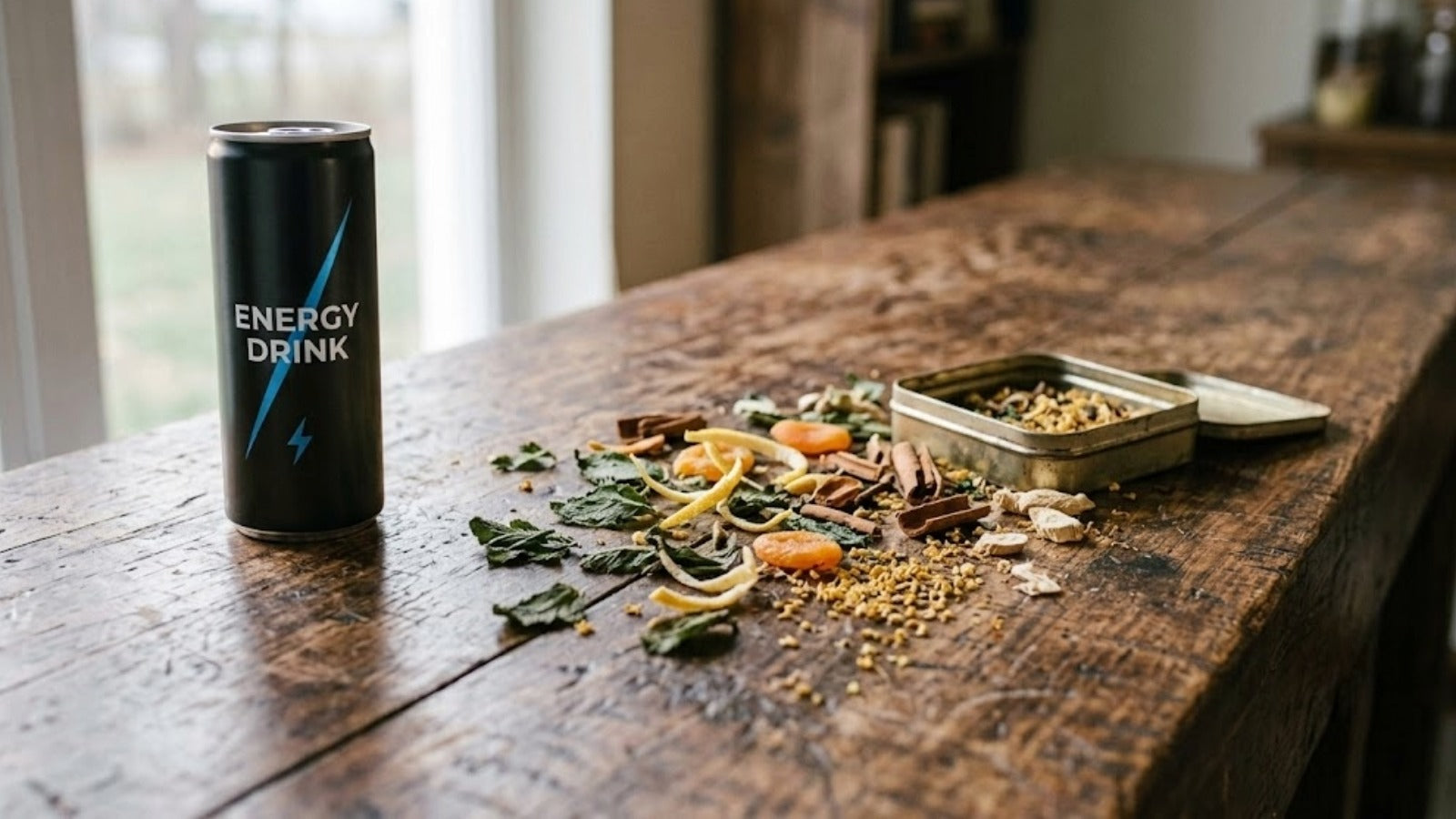
Every energy drink you have ever opened tasted the same as the last one, and that is not an accident. It is a manufactured product, engineered so that a can filled in March and drunk in the following February are the same drink. An herbal infusion is dried plants and hot water. Steep it longer, use more, make it exactly as strong as you want it. Nobody decided that for you in a factory.
That one fact drives everything else. One of these was built in a lab to survive a supply chain, and it does that beautifully. The other was blended by hand, botanical by botanical, by an expert blender deciding what you should taste first and what should stay with you after. One is engineered to be opened without a thought. The other is an invitation to stop for a few minutes in the middle of your day. If you have been thinking about what to drink instead of energy drinks, that invitation is the part worth taking seriously.
What an Energy Drink and an Herbal Infusion are Built For
An energy drink has a job beyond tasting good. It gets filled in one place, trucked to another, stored through a summer, and opened months later by someone who expects it to taste the way the last one did. That is a hard thing to ask of a liquid, and most of the ingredient panel is the answer to it. Preservatives so it keeps. Acidulants so it stays stable in the can. And a sweetener load set high enough to sit on top of the bitterness underneath, because caffeine is bitter and so is taurine, which is where a great deal of the sugar comes from. None of that is a flaw. It is what the format costs.

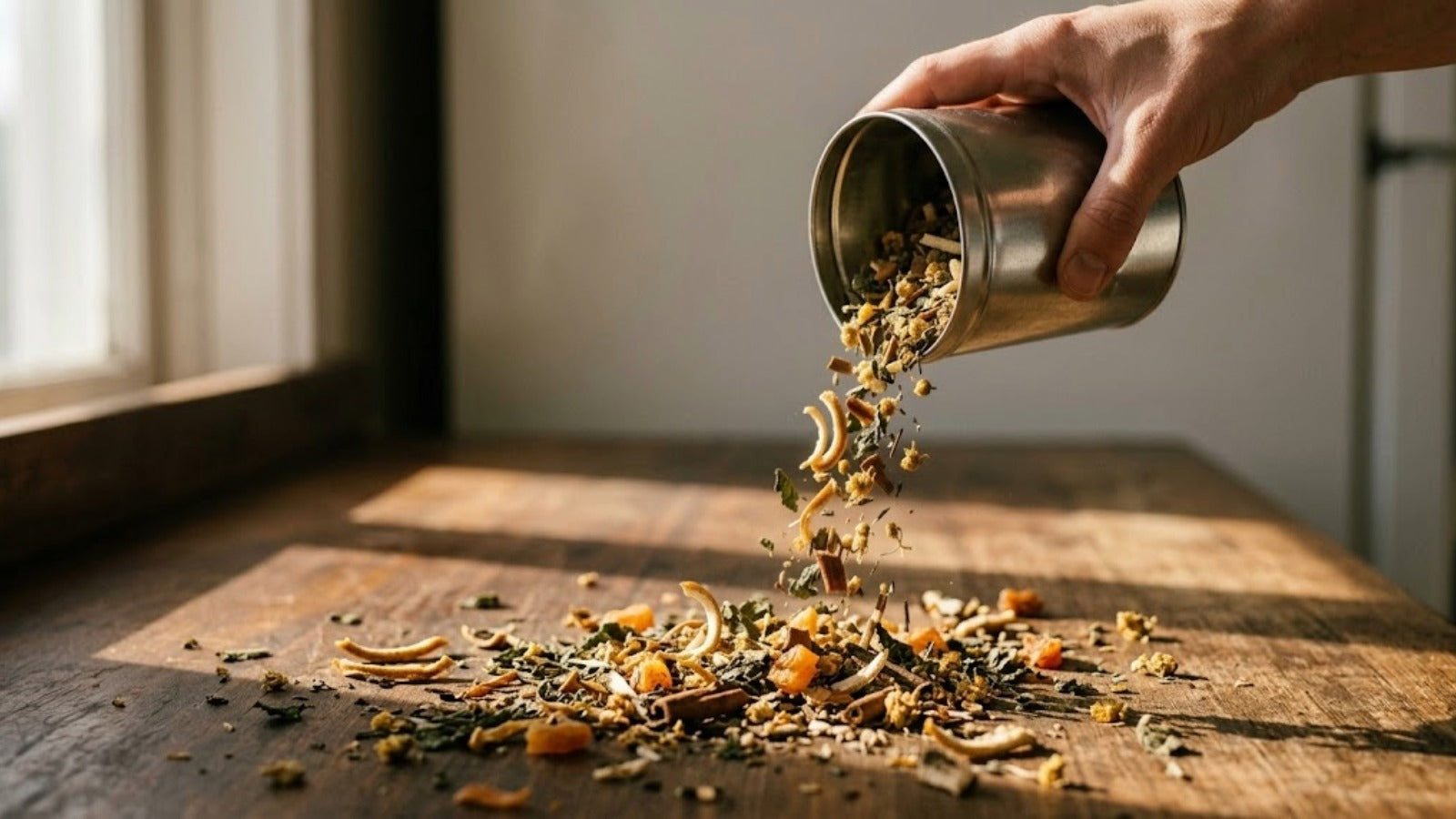
Dried botanicals have the same problem and answer it differently. Water is what lets things spoil, so a botanical that has been dried is already stable. A tin sits on a shelf for a year with nothing added to it, because there is nothing in it that wants to go off. Same engineering question, two solutions. One is solved with chemistry and one is solved by taking the water out first.
| Energy drink | Herbal infusion | |
|---|---|---|
| Ingredients listed | 15 to 25 | 9 |
| Sugar | 25 to 55g | None |
| Preservatives | Required | None |
| How it is made | Formulated to a spec | Blended by an expert |
| How you drink it | Opened, at your desk | Steeped, away from it |
Where the Energy Drink Wins
Carbonation, first, because there is no answer to it. Bubbles are a genuine pleasure and a herbal infusion does not have any. Nothing you can do to hot water and dried plants produces that, and anyone telling you a sparkling herbal drink is the same thing has not compared them side by side. Then convenience, which is not close either. You open a can in one motion. No kettle, no waiting, no strainer, no rinsing anything out afterward. If you work somewhere without hot water, this comparison ends here and the can wins by default.

And it tastes the same every time, which is worth taking seriously as a feature rather than dismissing as a limitation. You know exactly what you are getting before you open it, and you get it without doing anything. That consistency is precisely what the acidulants and preservatives and stabilizers are there to deliver. It is the product working as designed.
What an Herbal Infusion Gives You Instead
The cup is yours to make. Strong, mild, more of it, less of it; you decide, and you cannot get it wrong. More botanicals or a longer steep gives you a bigger cup, and because there is no tannin in an herbal infusion the way there is in black or green tea, leaving it too long does not turn it bitter. There is no version you can ruin. The same botanicals will usually give you a second steep as well, so a tin goes further than the total servings suggests. The energy drink made all of those decisions in a factory before you purchased it. Here they are yours to lean into.

Then there is what a blend actually is. Nine botanicals weighed against each other so that one arrives first and another stays on the finish, in an order somebody decided on. It is the same pleasure you get from a crafted bar of single origin chocolate or a wine from a small producer. And then there is the refresh, which is the part people underrate. Cultures that drink tea in the afternoon built a reset into the day on purpose, and they did it because the middle of the day needs one. An energy drink usually gets drunk at your desk while you keep plowing through work. A cup of tea is the one thing in your afternoon that invites you to stand still.
What You Want From the Afternoon
Every difference in this comparison comes down to the same split. One drink requires nothing to think about. You open it, it is cold, it tastes the way it always tastes, and you can do the whole thing without leaving your chair. Herbal tea invites you into a ritual, a moment in your afternoon where you make a cup with intention, at a strength you chose.
We think the invitation is worth taking. Not because the energy drink is necessarily bad, since it does exactly what it was built to do and does it well, but because an afternoon with something deliberate in it is better than one without. Making a cup is a small act of intention in a day that oftentimes does not have any. That is our preference and we will not pretend otherwise.
Two Blends Made with Intention for the Middle of Your Day
Both of these were built the way we have been describing. Botanicals chosen for what each imparts onto the cup, weighed against interactions, and ordered so that the first thing you taste and the last thing you taste were decided on purpose.
Guardian Spirit™ runs cool and clean. Spearmint arrives first, clean across the front of the palate, then lemon peel and lemon verbena lifting through it, bright and slightly sharp. Apricot sits underneath, warm and not sweet. Dandelion and licorice roots hold the base, and a trace of ceylon cinnamon stays on the finish. Nine botanicals, weighed against each other so they arrive in that order.
Celestial Renewal™ opens cooler and finishes warmer. Peppermint first, sharp and clean, then cacao and ceylon cinnamon coming in underneath with real weight to them. Orange peel and jasmine lift through the middle, and galangal settles at the base with a faint heat that stays. The cacao carries a trace of caffeine of its own, which is the one thing on that list that is not simply flavor.
Two cups for the same hour, pulling in different directions. The Midday Ritual Sampler carries both, which is the cheapest way to find out which you actually reach for.
Why the Afternoon Is Worth Getting Right
Intention is the whole difference. The energy drink was engineered to survive a warehouse, and it does that well. The tin was blended by hand, by someone deciding what you taste first and what stays with you. One of those is a solved logistics problem. The other is somebody making you a crafted drink with care.
The middle of the day is the part most people give away without noticing. The afternoon has a shape of its own, and it is worth understanding on its own terms rather than as the gap between lunch and dinner that something has to fill. Start with drinking tea in the afternoon, which covers what the hour actually asks for and which cup answers it.
Editorial Disclaimer
This content is for informational and educational purposes only. It reflects general perspectives on herbal tea, daily rituals, and related lifestyle practices. It is not intended to provide medical advice, diagnose conditions, or recommend treatments. Always consult a qualified healthcare professional with any questions about wellness or health related matters.