What's in an Energy Drink? Not Much That's Natural

Turn the can around. The ingredient panel runs longer than you remember, and most of what is on it does not sound like something you would order on purpose. Taurine. Glucuronolactone. Sodium citrate. Somewhere in the middle, guarana, which is a plant, sitting next to inositol, which is not.
That list is not a set of substances. It is a record of decisions. Every entry was chosen, dosed, and approved by someone, and the order they appear in tells you roughly how much of each one is in there. Read it that way and the can stops being a mystery and starts being a document, one that turns on a word you thought you already understood. Anyone working out what to drink instead of energy drinks is better served knowing what the formulation actually is before deciding what to keep from it.
What an Energy Drink Actually Contains
A standard energy drink is carbonated water and a sweetener, either sugar or a sugar substitute, carrying a measured dose of caffeine. Around that sit taurine and one or two other amino acid compounds, a run of B-vitamins, and one or more botanical names such as guarana or ginseng. The rest of the panel is acidulants, preservatives, coloring, and natural flavors.

Ingredients appear by weight, heaviest first, which is the single most useful thing to know about reading one. Water and sweetener sit at the top because they make up nearly all of the volume. The names the marketing is built on tend to appear well down the list, after the acidulants. A typical can runs somewhere between fifteen and twenty-five entries, which is a lot of decisions for a drink that arrives tasting like one thing.
Why the Ingredient List is so Long
Sort the panel into two piles and it gets easier to read. In the first pile: caffeine and sweetener. Those are the reason the product exists. In the second pile: everything else. Citric or phosphoric acid, there for shelf stability and for a sharpness that reads as refreshing when nothing tart is actually in the can. Sodium benzoate and potassium sorbate, because the drink is manufactured in one place, trucked to another, and expected to taste identical a year later. Coloring, because the liquid underneath is pale and unconvincing. A sweetener level set high enough to sit on top of caffeine, which is bitter, and taurine, which is also bitter.

Nothing in that second pile went into the drink because someone wanted it in the drink. It went in because the format demanded it. A sealed can that ships across a country, sits in storage through a summer, and opens tasting the same as the day it was filled is a hard engineering problem, and the ingredient panel is where the solution gets written down. Read it that way and the length stops being suspicious. Two or three entries are the product. The rest are what it takes to deliver those two or three to you intact, twelve months later, in aluminum.
What Taurine, Guarana, and Ginseng are Doing on the Label
Most of the panel is unmistakably manufactured. Three or four entries are not, and those are the ones the front of the can is built on. Taurine is an amino acid. It takes its name from ox bile, where chemists first isolated it in the eighteen hundreds, and the taurine in a beverage is synthesized in a factory with no ox involved at any stage. The name arrived first and stuck. It reads as biological, which is a useful thing for a word on a label to do.

Guarana is the entry worth slowing down on. The seed comes from a climbing plant native to the Amazon basin, it is genuinely botanical, and it carries caffeine of its own. That means a can listing guarana has a caffeine figure on the nutrition panel and a second caffeine source further down the ingredient list, and those two numbers are not always reconciled in the same place. Ginseng works differently. It is a root, it is real, and the label is not required to say how much of it is in there. What all three share is position: they are load-bearing on the front of the can and minor in the liquid. They are also the entries that make the whole panel read as natural, which is the first sign that the word is doing more work here than it looks like it is.
How Much Caffeine does an Energy Drink Contain?
A small energy drink runs somewhere near eighty milligrams. A standard sixteen-ounce can is usually closer to one hundred and sixty milligrams. The larger formats scale with volume rather than holding a fixed figure, so a twenty-four or thirty-two ounce can carry proportionally more, and some of those are labeled per serving on a container that holds two. The number on the front of the panel and the number in the can are then two different figures, and both are printed accurately.

Where guarana appears, its caffeine may or may not be folded into the stated total, and the panel does not always say which. That is not an omission so much as a gap in what the format requires. In the United States there is no federal rule obliging a conventional food or beverage to declare its caffeine content at all. Manufacturers who print a figure are choosing to. The number you are reading is one somebody decided to give you, calculated by a method they selected, and the absence of a number anywhere on a can does not mean there is nothing to report.
What "Natural Flavors" Really Means
The term has a legal definition. Under 21 CFR 101.22, a natural flavor is a substance derived from a spice, fruit, vegetable, herb, root, leaf, or comparable plant or animal material, whose purpose in the food is flavoring rather than nutrition. The requirement lands entirely on where the material started. What happens between the source and the finished compound is open, and it can include extraction, distillation, heating, fermentation, and enzymatic treatment. A compound can travel a long way from a leaf and still qualify.

The more useful thing to know is that the phrase is a container. A single line on a panel can stand for a blend of dozens of individual compounds, and the manufacturer is not required to itemize them, because the composition of a flavor system is a trade secret. So a panel that has just spent twenty entries naming precise chemicals down to the milligram closes on one entry that names nothing at all. That entry is frequently the one doing the most to determine what the drink tastes like when you open it.
What "Natural" Actually Means in an Afternoon Drink
There is an older way to make a drink, and it has been in use for thousands of years across nearly every culture that ever boiled a kettle. Egypt, China, Morocco, the Andes, every kitchen in between. Plants and hot water and a few minutes of waiting. Nothing gets built, because nothing needs to be. And the word natural means what you always thought it meant. Spearmint tastes like spearmint because it is spearmint, picked and dried and nothing else.
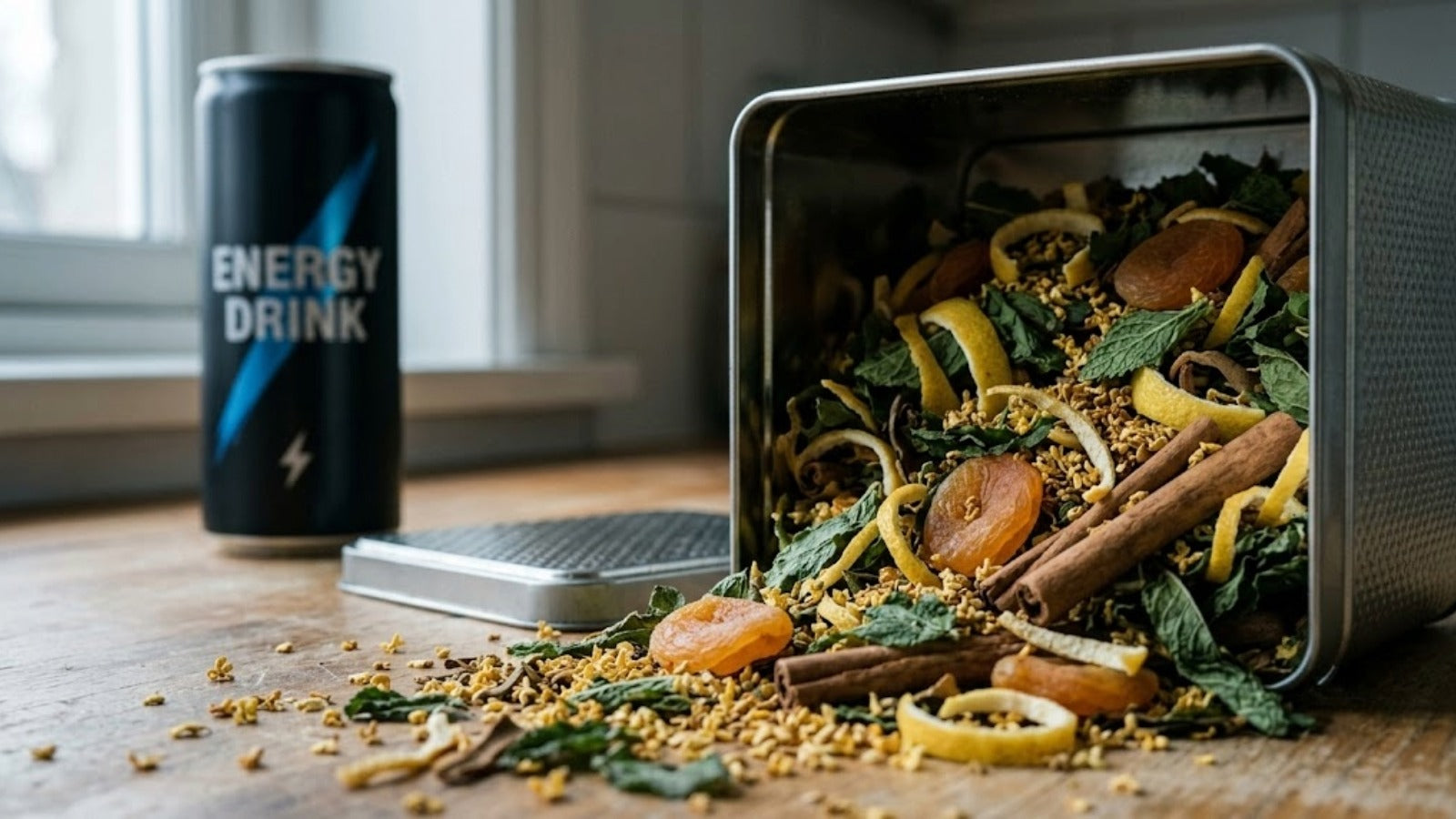
Pour Guardian Spirit™ and the first thing you get is the spearmint, cool and clean across the front of the palate. Lemon peel and lemon verbena come up through it a moment later, bright and a little sharp. Apricot sits underneath, soft and warm and not sweet. Osmanthus drifts somewhere in the middle, floral and gold. Then dandelion and licorice roots at the base, grounding the whole thing, and a trace of ceylon cinnamon that stays on the finish after you have swallowed.
Pour Celestial Renewal™ and it opens cooler and finishes warmer. Peppermint first, sharp and clean, then cacao and ceylon cinnamon filling in underneath with real weight to them. Orange peel and orange blossom lift through the middle, jasmine sitting just above. Galangal at the base, faintly hot, holding the whole thing down. The cacao carries a trace of natural caffeine, which is the one thing on this list that is not simply flavor, and it is there because some afternoons want a little behind the cup.
Two cups for the same hour, pulling in opposite directions. The Midday Ritual Sampler carries both, so the choice happens in the afternoon rather than at checkout.
Nine plants in each, doing what nine plants do in hot water. Nothing added to hold either one together or make it keep. That is the whole formulation, and it is a different thing to reach for in the afternoon than something that needs a panel to explain itself.
Why the Afternoon Deserves a Natural Cup
Reading a panel is a useful skill and it takes about a minute once you know the order. But the more interesting question is not what is in the can. It is what else you might reach for at the hour you usually open one.
The afternoon has its own logic, and it is worth understanding on its own terms rather than as the gap between lunch and dinner that something has to fill. Start with drinking tea in the afternoon, which covers what the hour actually asks for and which cup answers it.
Editorial Disclaimer
This content is for informational and educational purposes only. It reflects general perspectives on herbal tea, daily rituals, and related lifestyle practices. It is not intended to provide medical advice, diagnose conditions, or recommend treatments. Always consult a qualified healthcare professional with any questions about wellness or health related matters.