What to Drink in the Morning Instead of Coffee: A Complete Guide

If you want something to drink in the morning instead of coffee, the real options are caffeine-free herbal tea, chicory, roasted grain drinks, golden milk, cacao, mushroom blends, and decaf. That is the list, and most guides stop there. The list is the easy part.
The hard part is that most people who leave coffee are back at the coffee maker within a few weeks, and it is almost never because they picked the wrong drink. It is because they treated it as a subtraction: they removed the cup and left the space it occupied empty. So the useful question is not which drink tastes most like coffee. It is which one you will still want on the fortieth morning. That single test does most of the sorting. This guide walks the full field, and whichever drink you land on, the aim is not an empty morning but a full one, which is what drinking tea in the morning is really about.
Why Quitting Coffee Is So Hard
Coffee was never one thing. It was four, stacked in the same cup: a warm drink in your hands first thing, a routine so repeated it stopped being a decision, a few quiet minutes that belonged to you before the day started asking for anything, and caffeine. Only the last one is what people think they are quitting.

But when you stop making coffee, you do not remove one thing. You remove all four. Three of them you never had a problem with. The morning goes hollow, and what pulls you back a week later is not really a craving. It is the gap where a routine used to be.
Notice which mornings you actually cave on. They are the tired ones, the rushed ones, the ones where you slept badly or something is already going wrong. Those are exactly the mornings a warm, familiar cup would have helped most, and they are the mornings you have nothing to reach for. That is not a willpower problem. It is a design problem. A plan that only holds on your good mornings is not a plan.
The way through is almost embarrassingly simple, and it is the reason this guide exists. The three things you did not want to lose are the three things that have nothing to do with coffee. A warm drink, a repeated routine, a quiet pause: any decent replacement can carry all three. Caffeine is the only one that has to go, and it was the only one you were trying to remove in the first place. Which means the entire question is what goes in the cup.
Which Coffee-Alternatives Are Actually Caffeine-Free?
Before you can compare anything, you have to shrink the list, because several drinks that show up on every coffee-alternative list are not actually caffeine-free. Decaf still carries a small residual amount. Matcha and green tea come from the same plant as black tea and are naturally caffeinated. Yerba mate surprises people most: it gets described as a gentle herbal option, and its caffeine sits in coffee's range. Which side of that line you need depends on the road you are on. Cutting back and keeping a cup? Decaf is a legitimate tool. Leaving caffeine entirely? All three are a slow leak, and the coffee alternatives that are genuinely caffeine-free covers exactly which drinks clear the bar.

What is left divides into three groups, and they are not interchangeable. The coffee imitators, chicory and roasted grain and mushroom blends, are built to taste like coffee, which means they get measured against coffee every morning and lose by a little every morning. That comparison is their entire premise, and it wears thin. The warm-spice comforters, golden milk and cacao, are not imitating anything, but they are treats. Rich is the wrong register for the first cup of a Tuesday, and by the second week it feels heavy.
Then there is herbal tea, which belongs to neither group. It is not imitating coffee and it is not an indulgence, which means it is the only thing on the list not asking to be compared to something else. It has nothing to lose against. It only has to be a good cup. None of that makes herbal tea objectively better. It makes it better at repetition, and repetition is the whole test. If you want a coffee alternative once a month, chicory is excellent. If you want one every morning for a year, the field narrows fast.
Herbal Tea vs Coffee: What You Give Up
Here is the part most coffee-alternative guides will not say plainly: nothing on that list does what coffee does. Not chicory, not golden milk, not herbal tea. Coffee delivers a fast, reliable chemical lift, and if you are running on four hours of sleep with somewhere to be, no caffeine-free cup is going to rescue that morning. Pretending otherwise just sets you up to fail on the exact mornings that matter most.

But it is worth being precise about what that lift actually is. Caffeine does not create energy. It blocks the signal that tells you how tired you are, which means the tiredness is still accumulating quietly underneath while you feel fine. When the caffeine clears, it all arrives at once, and that is the afternoon you already know. So the real trade is not energy for no energy. It is a fast morning followed by a dip in exchange for a day that stays more or less level. Plenty of people look at those two deals and take the first one, and that is a reasonable choice rather than a failure of nerve. It is worth understanding how herbal tea and coffee compare in the morning before you decide which trade you want.
What you do not give up is everything else. The warm cup stays. The routine stays. The few quiet minutes stay. You are handing back one thing and keeping three, which is the whole reason this works better as a swap than a sacrifice.
Cutting Back on Coffee vs Quitting Entirely
There are two ways out of coffee, and you probably already know which one you are on. You have just not said it out loud yet, which is why the plan has stayed vague.

Cutting back means coffee stays and the amount comes down. You swap one cup, not all of them, and you let each step feel normal before you take the next one. The bar is lower here in a useful way: decaf and matcha are legitimate tools, because the goal is less caffeine rather than none. Nothing about the morning has to disappear at all. If this is the road you are on, the approach is simply to cut back on coffee without losing your morning ritual.
Quitting is a different job. The bar moves to zero, which puts decaf and matcha back on the shelf, and the replacement has to be genuinely caffeine-free or it is only a slower version of the same habit. It also has to be in the cupboard before you need it. The first hard morning does not send you a warning, and if the only thing in the house is coffee, coffee is what you will make. That is where most quits actually break, and it is worth reading what to drink instead when you are quitting coffee for good before you start rather than after.
These are not two intensities of the same plan. They are two plans with different rules, and they fail in different ways. Cutting back fails when you move too fast. Quitting fails when the replacement is not ready. Pick the wrong playbook and you will fail for reasons that have nothing to do with how much you wanted it.
Bright, Fruit-Forward Blends to Start With
If herbal tea is where you land, the blend matters more than it might seem, because it has to survive the fortieth morning. Bright, fruit-forward profiles work best first thing: light enough to drink on an empty stomach, colorful enough to feel like a real start, and genuinely caffeine-free. These two Morning blends are built for exactly that.
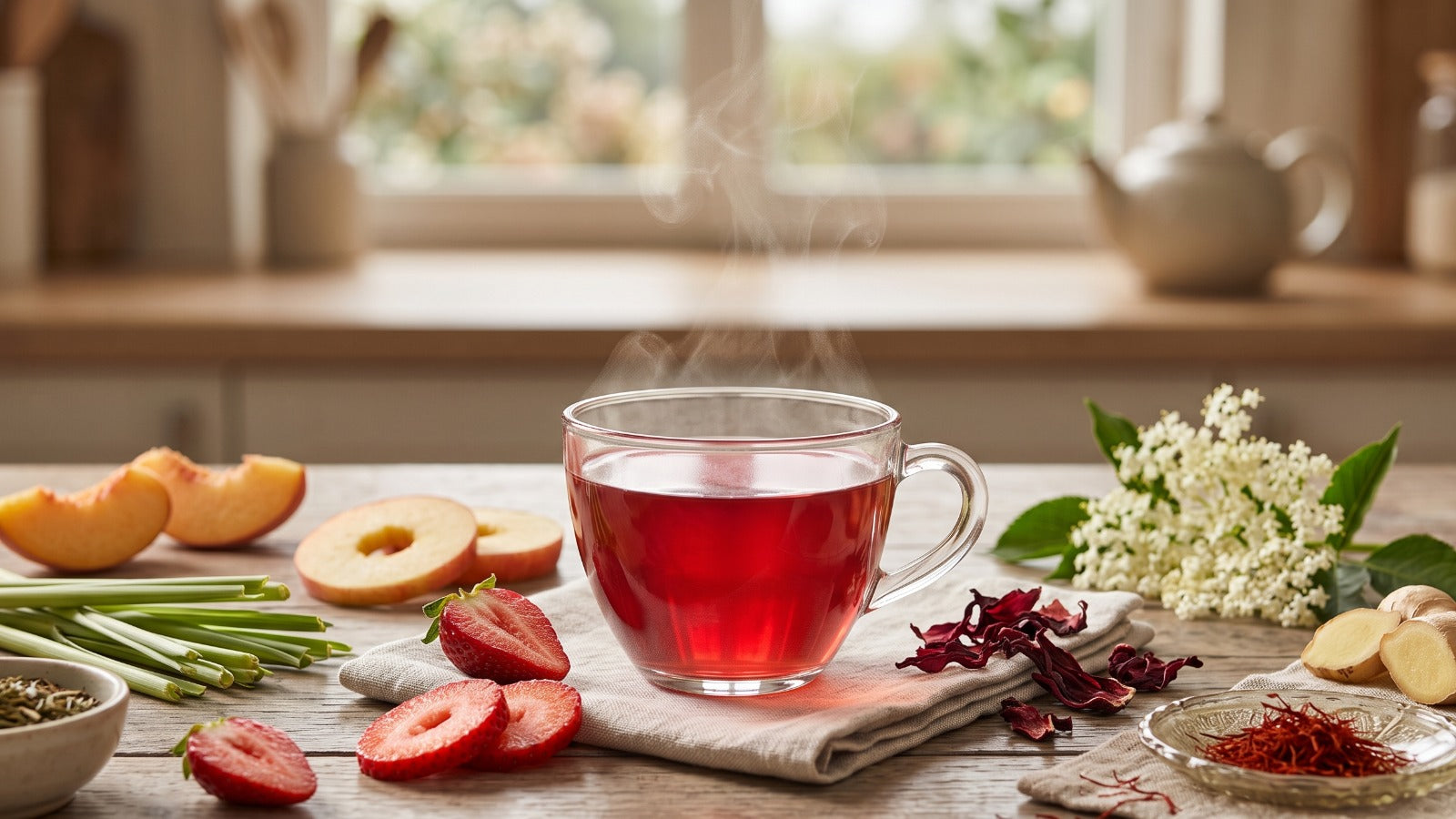
Sunrise Clarity™ — Ripe strawberry, peach, and apple at the center, jammy and full. Hibiscus and elderflower add a soft floral lift; lemongrass keeps it clean. Underneath, ginger root and a thread of saffron give the cup a warm, golden finish, with green rooibos as a smooth, caffeine-free base.
Radiant Awakening™ — Pineapple and mango come in vivid and sun-sweet, then coconut softens the edges. Rose petals and hibiscus add a floral glow; lemongrass brings a citrus snap. Green rooibos holds a clean, light, caffeine-free base.
Morning Ritual Sampler — The fortieth-morning test is not one you can run at checkout. The sampler puts both Morning blends in front of you so the cup you keep is the one you actually chose, over a few real mornings rather than in a single guess. Genuinely caffeine-free, and the simplest place to start.
Any of the three gives you a warm, colorful cup to make the same way each morning, which is the part that has to hold. The blend is what makes it worth reaching for. The repetition is what makes it a ritual.
Starting Your Caffeine-Free Morning
Leaving coffee is not really about coffee. It is about whether the thing you put in its place can hold the space coffee was holding, which is why the drink matters far less than most guides suggest and the repetition matters far more. Chicory, golden milk, herbal tea: any of them can work if you actually reach for them on the fortieth morning, and none of them will if you do not.
So start with one cup, make it the same way tomorrow, and let it become the thing you do without deciding to. The warm drink stays, the routine stays, the quiet few minutes stay. Only the caffeine leaves, which was the only part you were trying to remove.
Editorial Disclaimer
This content is for informational and educational purposes only. It reflects general perspectives on herbal tea, daily rituals, and related lifestyle practices. It is not intended to provide medical advice, diagnose conditions, or recommend treatments. Always consult a qualified healthcare professional with any questions about wellness or health-related matters.