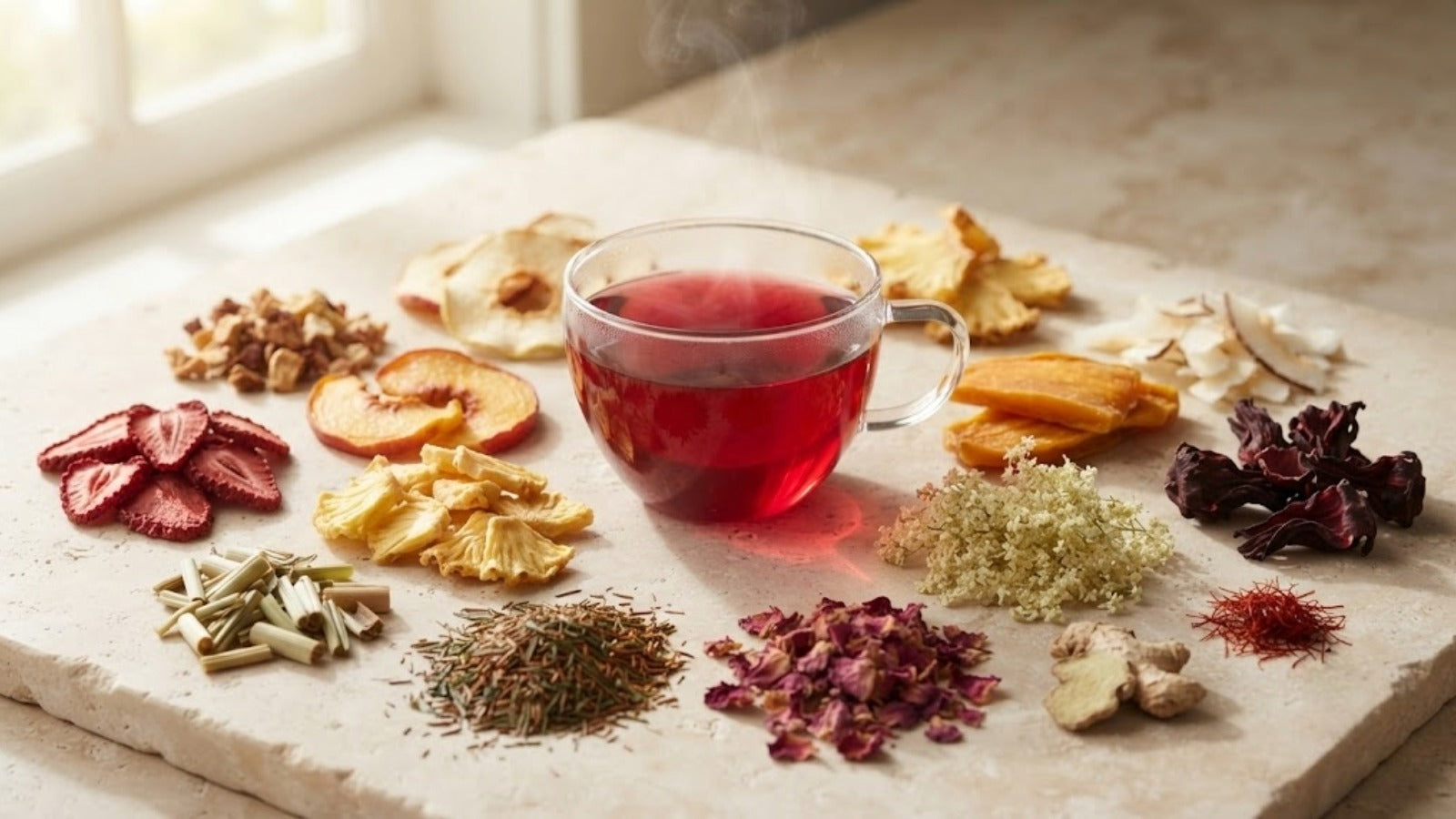
Fruit Herbal Tea: A Complete Guide to Real Fruit Tea

Fruit herbal tea is not tea. There is no leaf in it. It is dried fruit and botanicals in hot water, which is why it has no caffeine, and why it does not taste like anything you have had from a supermarket box with fruit on the front.
Most of what gets sold as fruit tea is a black or green tea sprayed with flavoring. The real thing is a different drink entirely: sweet without sugar, deep in color, and still changing in the cup ten minutes after you poured it. Here is what it is, what it tastes like, and which one to start with, and why it earns its place in drinking tea in the morning.
What Is Fruit Herbal Tea?
Tea is one plant. Camellia sinensis, the leaf that gives you black, green, white, and oolong, and the caffeine that comes with all of them. Fruit herbal tea contains none of it. What is in the cup is dried fruit and botanicals, steeped the same way you would steep tea, which is where the name comes from and where the resemblance ends.

That is why it has no caffeine. Not because the caffeine was removed, but because it was never there. A blend built on green rooibos, a South African shrub with no caffeine in any quantity, is caffeine-free by construction rather than by processing. Nothing was taken out of it.
The confusion is worth naming, because it is where most people get caught. A lot of what sits on a shelf labelled fruit tea is a black or green tea base with fruit flavoring applied to it. That has caffeine in it, sometimes a great deal, and no meaningful amount of fruit. It is tea with fruit on it. This is fruit, without the tea.
What Does Fruit Herbal Tea Taste Like?
Sweet, but not the way a drink is usually sweet. There is no sugar in it and nothing has been added to make it taste like more than it is. What you get is the sweetness the fruit already had, concentrated by drying, which is rounder and less insistent than sugar and does not leave anything behind on your teeth.

The other thing you notice is that it moves. Aroma comes up in the steam first, before you have sat down. Color builds in the glass over the first minute or two, going from a faint tint into coral or deep red or gold depending on what is in the blend. Flavor arrives last and keeps developing while you drink it, so the sip at two minutes is not the sip at six.
That is the part most people are not expecting, and it is the whole pleasure of the thing. A cup that is still becoming something while you hold it is a cup worth paying a little attention to. There is more on what real fruit does during the steep, and why the brightness of a fruit cup is structural rather than decorative.
Real Fruit Tea vs Fruit-Flavored Tea
Here is the test, and you can run it on anything already in your cupboard. Pour hot water on it and count to ten. If the cup is already at full color and full smell, there is no fruit in it. The flavor was sprayed onto the outside of a neutral base and it came off all at once, because there was nothing else in there to come off.

Real fruit cannot do that. It has to take on water before it releases anything, which is why the cup keeps changing for minutes rather than seconds, and why it is nearly impossible to over-steep. Four minutes or nine, the fruit is still working.
Most tea is not made this way because it costs more. Drying whole fruit slowly, at low heat, in small trays takes time and yields less. Flavoring is cheap and instant. That gap is getting harder to hide, and as more people notice it, they are switching to real fruit tea.
Berry Herbal Tea: Strawberry, Peach, Apple
Strawberry, peach, and apple. It is the familiar one, and familiarity is the point rather than a compromise. You already know exactly what these three should taste like, which means you notice immediately when a cup gets it right.

The cup goes deep red within a minute and the smell that comes up is warm strawberry, closer to jam than to fruit eaten cold. Peach fills in behind it, soft and golden. Apple cuts the finish clean so the whole thing does not turn syrupy on you. Sweet, warm, and easy to drink at six in the morning on an empty stomach.
It is the one to pick if you want comfort rather than novelty. There is more on what goes into a berry herbal tea, and on how strawberry, peach, and apple behave in the cup.
Tropical Herbal Tea: Pineapple, Mango, Coconut
Pineapple, mango, and coconut. This is the one that goes somewhere. Not comfort so much as displacement: for the four minutes it takes to drink, the kitchen smells like somewhere considerably warmer than wherever you are actually standing.

Pineapple arrives first, bright and a little sharp, coming up in the steam while the water is still going gold. Mango follows, rounder and heavier, the sweetness of fruit that sat in the sun too long and got better for it. Coconut lands last and softens everything, so the finish is smooth rather than abrupt.
Pick it if you want the cup to be an event rather than a habit. There is more on what a tropical herbal tea actually tastes like, and on how pineapple, mango, and coconut work together.
The Best Fruit Herbal Tea to Start With
Both blends are built the slow way. Whole fruit, dried in-house on small trays at low heat, nothing sprayed on and nothing added after. It costs more and yields less, which is the entire reason most tea is not made like this.
Sunrise Clarity™ — Ripe strawberry, peach, and apple at the center, jammy and full. Hibiscus and elderflower add a soft floral lift; lemongrass keeps it clean. Underneath, ginger root and a thread of saffron give the cup a warm, golden finish, with green rooibos as a smooth, caffeine-free base.
Radiant Awakening™ — Pineapple and mango come in vivid and sun-sweet, then coconut softens the edges. Rose petals and hibiscus add a floral glow; lemongrass brings a citrus snap. Green rooibos holds a clean, light, caffeine-free base.
Morning Ritual Sampler — Berry or tropical is not a question you can answer at checkout. The sampler puts both in front of you, so the cup you keep is the one you chose across a few real mornings rather than in a single guess. Genuinely caffeine-free, and the simplest place to start.
Why Fruit Herbal Tea Is Worth Drinking
The whole appeal comes down to one thing: it is made of what it says it is made of. Nine ingredients, all of them plants, none of them a mystery. No caffeine, no sugar, nothing sprayed on, and nothing you would need to look up.
That is a low bar and increasingly a rare one. A cup that is still becoming something while you drink it, sweet without needing to be sweetened, and impossible to get wrong at an hour when you are not paying attention. It is the easiest thing in your morning to keep doing tomorrow.
Editorial Disclaimer
This content is for informational and educational purposes only. It reflects general perspectives on herbal tea, daily rituals, and related lifestyle practices. It is not intended to provide medical advice, diagnose conditions, or recommend treatments. Always consult a qualified healthcare professional with any questions about wellness or health related matters.