Fruit-Infused Herbal Tea: What Real Fruit Does in the Cup

Fruit tea has a reputation problem. Most of what gets sold under that name is flavoring sprayed onto a neutral base, which is why it hits full color in about ten seconds and then does nothing else for the rest of the steep. Real fruit behaves differently, and in the morning that difference is easy to see.
Color builds gradually. Aroma arrives before flavor. The cup tells you where it is without a timer. That legibility is what makes fruit herbal tea suited to the early hours, when the palate is at its most sensitive and the day has not yet made demands. Here is what fruit actually does in a morning cup, and why brightness turns out to be structural rather than decorative.
How Fruit Behaves in a Morning Tea Steep
Drop real fruit into hot water and it takes a few minutes to give itself up. The pieces have to rehydrate before they release anything, which is why the cup keeps changing: color deepens at one minute and again at three, aroma lifts before flavor arrives, and the profile is still moving when you sit down with it. Flavored tea does none of this. It arrives complete in the first ten seconds and then holds still.

The practical result is forgiveness. Because the fruit releases over a window rather than at a point, the steep survives inexactness: five minutes and eight minutes both produce a good cup, just a slightly different one. That matters at seven in the morning, when nobody is timing anything.
Why Brightness Matters in Morning Tea
Brightness sounds like a flavor note. It is closer to a structural property. In a morning blend, fruit creates the lift, herbs hold the center, and roots add a low warmth underneath, and brightness is what happens when those three arrive in the right order.

You can watch it form. The infusion moves from a faint tint into soft pinks, corals, or warm golds within the first minute, and the shade tells you what is in the blend: strawberry and apple give clear, gentle hues, peach warms the tone, pineapple and mango push toward gold. That color is the fruit acids and aromatics releasing, which is also why the cup smells like something before it tastes like anything.
This matters more in the morning than at any other hour. The palate is at its most sensitive first thing, and a heavy opening lands badly. Brightness gives the cup presence without weight, which is a harder thing to build than it sounds and the reason fruit earns its place at the front of a morning blend rather than the back.
Botanicals That Support Fruit-Forward Morning Tea
Fruit leads the cup, but it cannot hold the cup alone. Left unsupported, a fruit blend goes linear: bright at the front, thin everywhere else. The supporting botanicals are what give it a middle and a finish.

Green rooibos forms the base. It hydrates fast, releases a smooth low-bitter body, and gives fruit acidity somewhere to sit without interference. Lemongrass runs a clean citrus line through the middle, keeping the profile defined as the cup cools. Hibiscus does two jobs at once: it contributes controlled acidity and it colors the water within the first minute, which is how you know the steep is underway before you taste anything.
Underneath, ginger root adds a low aromatic warmth that rounds the edges without adding weight, and saffron threads a fine golden depth through the finish. Rose and elderflower soften the transitions between fruit and base, usually noticed in aroma before flavor.
None of these announce themselves. That is the point. They exist so the fruit can be bright without being sharp, and so the cup still has somewhere to go after the first sip.
Fruit-Forward Morning Blends to Start With
Everything above is only useful if the fruit in the cup is real. Most fruit tea is flavoring sprayed onto a neutral base, which is why it hits full color in seconds and then does nothing else. Purely dehydrates its fruit in-house, small trays, low heat, nothing added, which is what gives the steep something to actually release. Two Morning blends, two directions.
Sunrise Clarity™ — Ripe strawberry, peach, and apple at the center, jammy and full. Hibiscus and elderflower add a soft floral lift; lemongrass keeps it clean. Underneath, ginger root and a thread of saffron give the cup a warm, golden finish, with green rooibos as a smooth, caffeine-free base.
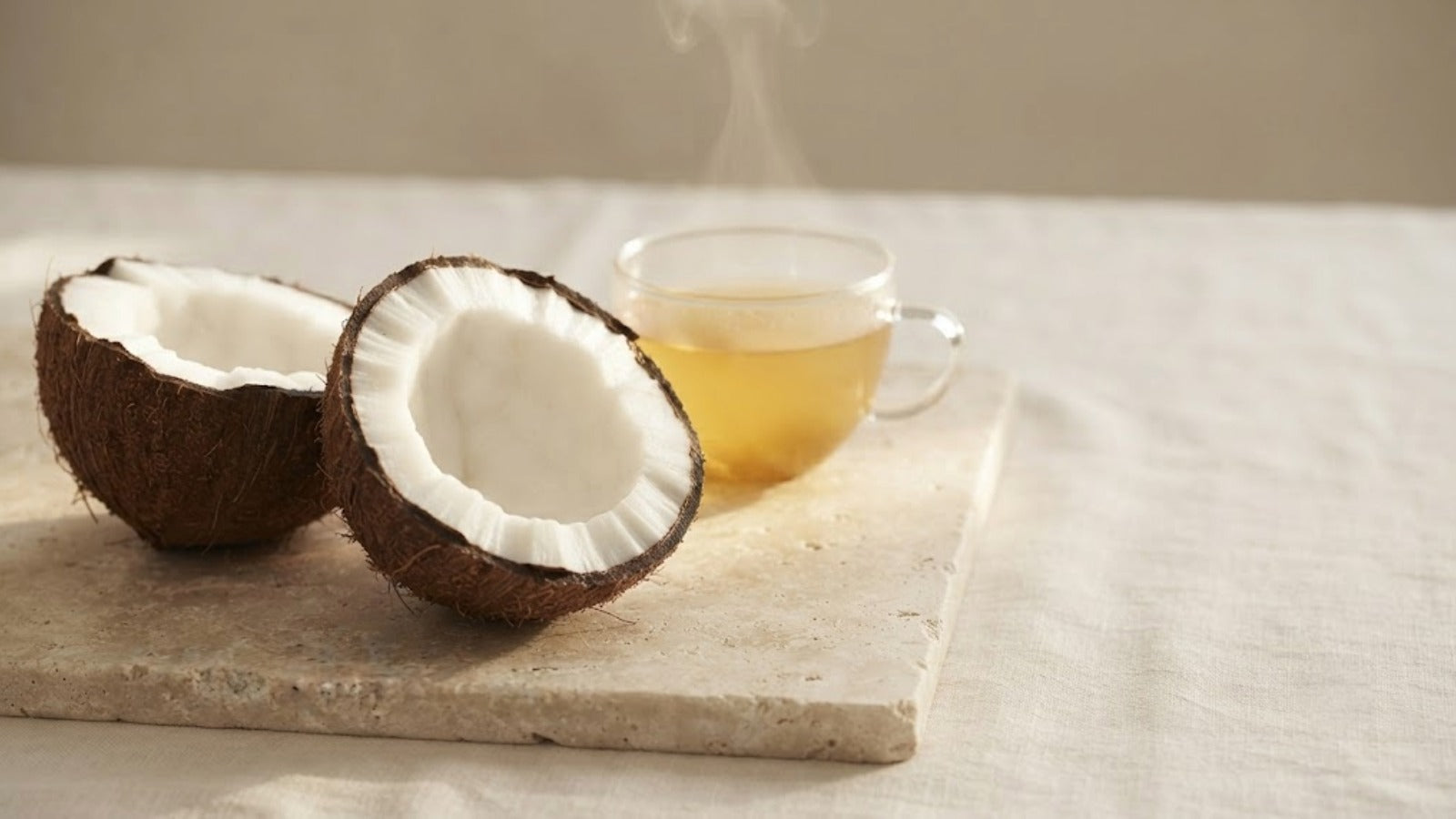
Radiant Awakening™ — Pineapple and mango come in vivid and sun-sweet, then coconut softens the edges. Rose petals and hibiscus add a floral glow; lemongrass brings a citrus snap. Green rooibos holds a clean, light, caffeine-free base.
Morning Ritual Sampler — Which lane suits your morning is not a question you can answer at checkout. The sampler puts both Morning blends in front of you, so the cup you keep is the one you chose across a few real mornings rather than in a single guess. Genuinely caffeine-free, and the simplest place to start.
Fruit, Light, and the Morning Cup
Whichever ends up in the cup, the same thing happens in the cup. Color gathers, steam softens, and the infusion settles into clarity as it cools. These are markers you can follow without measuring anything, which is most of why fruit feels natural at daybreak: it moves at roughly the pace the morning does.
None of that works if there is nothing in the blend to release. It is the fruit itself, dried slowly and left alone, that gives the steep something to unfold. That unfolding sits inside a larger rhythm, one shaped by how the whole practice of drinking tea in the morning uses light, warmth, and small repeatable gestures to invite presence.
Editorial Disclaimer
This content is for informational and educational purposes only. It reflects general perspectives on herbal tea, daily rituals, and related lifestyle practices. It is not intended to provide medical advice, diagnose conditions, or recommend treatments. Always consult a qualified healthcare professional with any questions about wellness or health related matters.