How to Make Herbal Tea Stronger

The standard advice is to use one teaspoon per cup. For certain kinds of single botanical that works: two grams of green rooibos in eight ounces of water gives you a proper cup, and one ingredient at one density is simple to measure. Not all botanicals carry the same density, though, and a crafted blend is where that advice falls apart, because different botanicals at different weights are sharing the same scoop. A scoop of a single botanical is nothing like a scoop of a blend. If your tea keeps coming out thin, the problem is not that you are being stingy. The problem is your spoon. For the broader basics behind why herbal tea follows different brewing rules, start with Herbal Tea for Beginners: Why the Usual Tea Rules Do Not Apply.
How Much Herbal Tea Per Cup?
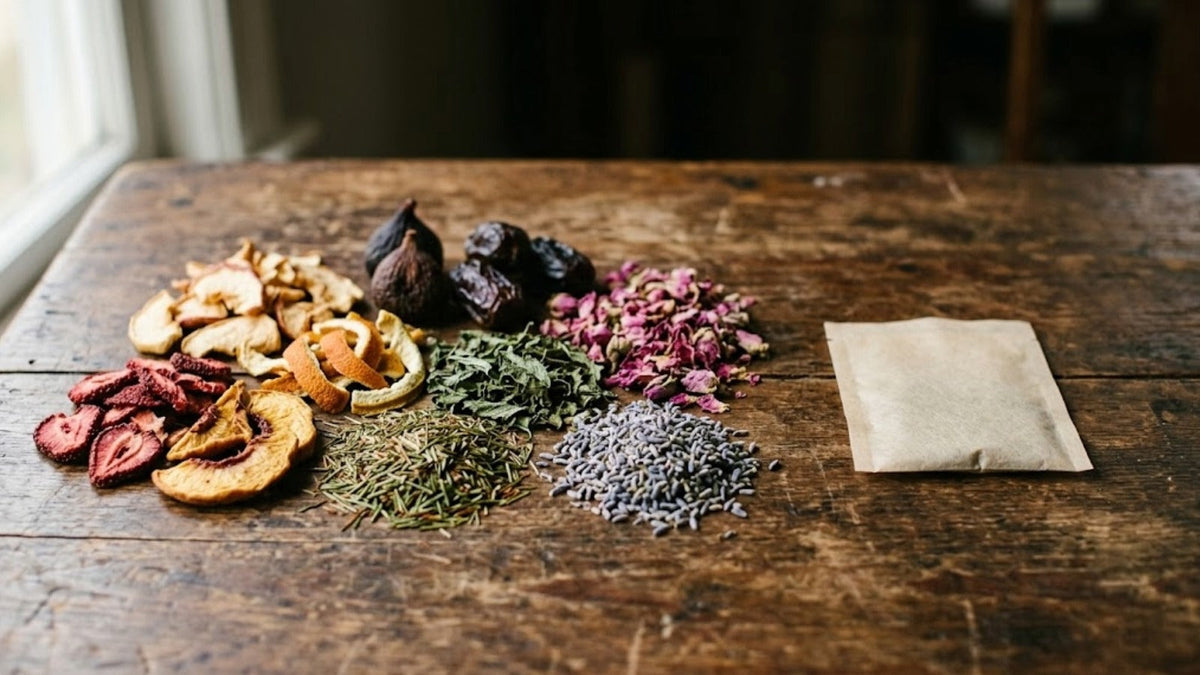
Pack a tablespoon with whole dried chamomile flowers and you are holding mostly air. The flower heads are light and hollow and they do not sit close together, so a good part of what fills that spoon is the gap between them. Now fill the same tablespoon with cut dandelion root, which is dense and heavy and packs tight, and you are holding several times as much actual plant. This is why adding a second scoop of a light blend often changes very little. You added more air.

The fix is to stop measuring by volume and start weighing. A kitchen scale settles it, because grams do not care whether your blend is fluffy or dense. Botanicals differ enormously in density, so a level tablespoon of one is nothing like a level tablespoon of another. To prove it, here are some of the most common botanicals, each measured with the same spoon and never pressed down.
| Botanical | One level tablespoon | Tablespoons to reach 10 grams |
|---|---|---|
| Chamomile flowers, whole | 1.2 g | 8.3 |
| Hibiscus petals | 2.2 g | 4.5 |
| Peppermint or spearmint leaf | 1.5g | 6.7 |
| Lavender buds | 2.0 g | 5.0 |
| Rooibos | 3.2 g | 3.1 |
| Dried apple or strawberry pieces | 4.0 g | 2.5 |
| Cinnamon bark, broken pieces | 4.5 g | 2.2 |
| Dandelion root, cut | 5.0 g | 2.0 |
| Marshmallow root, cut | 2.8 g | 3.6 |
Now a blend is some mixture of different botanicals, which is why there is no single right number of spoonfuls and no way to work it out by looking. Weigh it once, see what your usual scoop actually delivers, and you will not have to think about it again.
What to Brew Herbal Tea In
Boiling water starts cooling the moment it leaves the kettle. If you are steeping your herbal tea in an open mug for the whole steep, a long steep sits at a temperature well below the temperature you poured. There are several good options for steeping your herbal tea.

| What you brew in | How well it holds heat | Who it suits |
|---|---|---|
| Teapot with a lid, or a French press | Best | Thick walls, a closed top, and enough water in it that the whole pot cools slowly. Nothing to fix if this is you |
| Mug with a lid, or an infuser travel mug | Nearly as good | A smaller amount of water cools faster, but the seal does most of the work |
| Mug with a saucer or small plate on top | Good enough | The fix if you own neither of the above. Costs nothing and takes a second |
| Open mug with a basket or a tea ball | Worst | The most common way people brew herbal tea, and the one losing the most heat |
If you are going to buy a device, we suggest a teapot with a lid, which is the most effective for a long steep, and will hold enough liquid to serve yourself multiple cups. If that's not an option, the best approach is to simply put a plate over your mug. The heat and smell will stay trapped better, which actually matters because a good part of what you taste is what you smell as you lift your cup.
Can You Re-Steep Herbal Tea? And Other Techniques That Will Not Help.
No. And unlike some teas, such as oolong, reusing botanicals in a second steep will not work. If you pour a second cup of boiling water over the same botanicals your drink will be much paler than the first cup, not stronger. Tea leaves can take a second and third steep because they hold a great deal in reserve. Dried fruit, flowers, and roots do not work that way, and one good long steep takes nearly everything they have to give.

The other technique that will not help is to add more botanicals when they are old. What gives dried fruit and flowers their smell are light oils that sit near the surface, and those drift off over months in a cupboard. What you are left with is the woody part of the plant, which holds its shape and its color and almost none of its flavor. If your blend smells faint in the bag before it ever reaches the water, extra scoops or extra time will unlikely bring it back.
So, How Strong Should Herbal Tea Really Be?
Stronger than most guidance suggests. The teaspoon-per-cup rule everyone repeats was written for finely cut tea leaves, and it got copied onto herbal tea without anybody checking whether it still applied. It does not. Weigh your blend, use more than one teaspoon, cover the cup if you have no teapot, and let your botanicals brew from longer than the packet says. Nothing bad happens if you overdo it, which is the quiet advantage herbal tea has over every other kind: with no tea leaf in the cup, there is no way to overdo it. For the broader foundation behind that approach, explore our guide to what herbal tea is, how it works, and when to drink it.
Editorial Disclaimer
This content is for informational and educational purposes only. It reflects general perspectives on herbal tea, daily rituals, and related lifestyle practices. It is not intended to provide medical advice, diagnose conditions, or recommend treatments. Always consult a qualified healthcare professional with any questions about wellness or health-related matters.