Loose Leaf vs Tea Bags: Why Herbal Tea Changes the Answer

At Purely, we tell our customers that herbal tea is worth buying loose, but not for the reason tea sellers give. Their case is always the same: whole leaves beat broken dust, leaves want room to open, and small pieces turn the water bitter fast. Those three arguments are arguments about tea leaves, and tea leaves come from one plant, Camellia sinensis. Herbal tea is different. Your chamomile does not contain that plant. Neither does your peppermint, your rooibos, or the fruit blend in the back of your cupboard. Open an herbal blend and you are looking at fig, cinnamon bark, dandelion root, rose petals, and mint that was never rolled up, so there is nothing to open. For the broader basics behind why herbal tea follows different rules, start with Herbal Tea for Beginners: Why the Usual Tea Rules Do Not Apply.
Loose Leaf or Tea Bags: Which Should You Buy?
We keep it simple. Count the ingredients on the label, then find your row.
| What you are buying | What to buy it as | Why |
|---|---|---|
| A blend with seven or more ingredients | Loose | The blender set a ratio between those ingredients. A bag cannot hold that ratio steady |
| One botanical on its own, like peppermint or chamomile | Either one | There is no ratio to protect. Loose is fresher, a bag is easier |
| Tea you drink at a desk, in a hotel, on a plane | Bags | A bag needs no infuser and travels in a pocket |
| A blend cut fine, heavy on root and bark | Loose, in a mesh basket | Fine pieces slip through the holes of a metal tea ball and settle in the bottom of the mug |
Where Tea Bags Are Better Than Loose Leaf
We are in the business of selling loose tea and nothing else, so take the following as a seller telling you where the other format wins.

The finest pieces stay in the tea bag. Ground cinnamon and finely cut root can slip through the holes of your standard metal tea ball and settle at the bottom of the mug. This is worth considering, however a mesh basket with a fine weave will solve this.
The tea bag was already measured. A bag is portioned at the factory. A spoon is not, and botanicals differ enormously in density, so one level spoon of whole chamomile flowers is mostly air while one level spoon of cut dandelion root is nearly solid. After two- or three-times brewing, you will develop a feel for what a spoon of your blend should look like.
Tea bags involve slightly less clean up. A used bag goes in the bin. Loose botanicals get tipped out of the basket and the basket gets rinsed, which takes a few seconds longer.
No tools needed to brew a tea bag. No infuser, no basket, no strainer.
Why Loose Herbal Tea Is Better, and Not for the Reason You Would Think
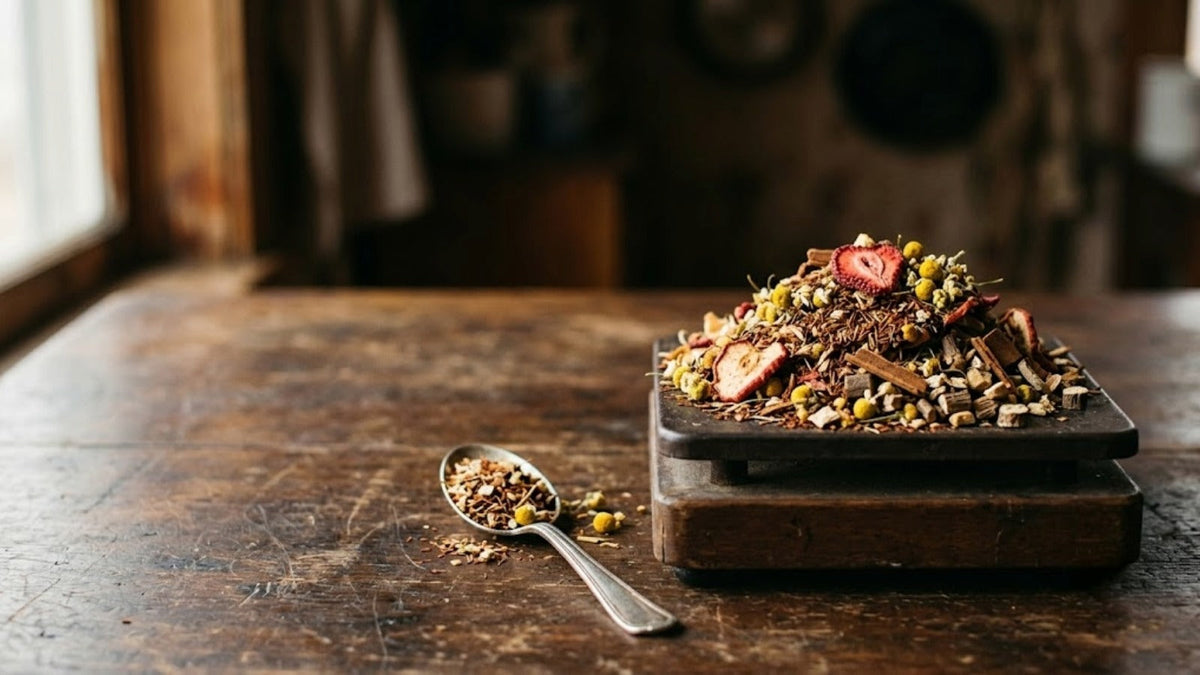
Open a bag of Sunrise Clarity and the smell arrives before you have brewed anything: strawberry first, then something warmer underneath it. The strawberry is in pieces you could pick out and eat. The peach is leathery and dark at the edges where it dried. Whole elderflower heads, a green rooibos base cut fine as pine needles, and here and there a thread of saffron, three or four of them in a scoop. You can check every one of those against the ingredient list, which matters more than it sounds in a category where most fruit tea is flavoring sprayed onto a neutral base. A sealed bag asks you to take the label's word for it.

Tea sellers are right about tea. Tea leaves hold a bitter compound called tannin and broken-up leaves release it fast enough to turn a cup harsh, which is the entire case against tea bags. Herbal tea does not work that way, because chamomile, fig, rose petals, and dandelion root have nothing in them waiting to turn the drink harsh.
The real reason to buy herbal tea loose is a different one. A blend is a recipe with specific proportions. Hibiscus makes up about two percent of a fruit blend, where it adds brightness. Push it to five percent and the drink turns sour and the color goes purple. Every tea bag has to hold that same recipe in about two grams, and fruit, petals, and root are hard to portion evenly because they are different sizes and weights. A loose blend gets mixed once, in a large batch, and the proportions stay right.
None of which means a blend cannot be bagged. It can, and some are. What it takes is weighing every unit rather than scooping it, and the cheaper way to solve that is to grind the botanicals down until they all pour the same, which costs you the reason to buy a blend built from whole pieces in the first place. Two grams is also a small space. A whole fig does not fit in it. Neither does a stick of cinnamon bark.
Should You Buy Herbal Tea Loose or in Bags?
At Purely, we blend nine botanicals to a set of proportions and sell them loose, because loose is the format that keeps those proportions intact without grinding the pieces down. That is why the blend tastes the same in November as it did in June. One botanical on its own is a different question, and there a bag is a reasonable thing to buy.
There is also the part that has nothing to do with proportions. A spoon of loose blend is a handful of a real harvest: a fig somebody dried slowly, petals that were a flower in April, three threads of saffron. You can hold it up to the light before it goes in the water. Nothing about a sealed bag is worse for you, but nothing about it is worth looking at either, and those few seconds of looking are most of what makes it a crafted cup you want to return to. For the broader foundation behind that approach, explore our guide to what herbal tea is, how it works, and when to drink it.
Editorial Disclaimer
This content is for informational and educational purposes only. It reflects general perspectives on herbal tea, daily rituals, and related lifestyle practices. It is not intended to provide medical advice, diagnose conditions, or recommend treatments. Always consult a qualified healthcare professional with any questions about wellness or health-related matters.