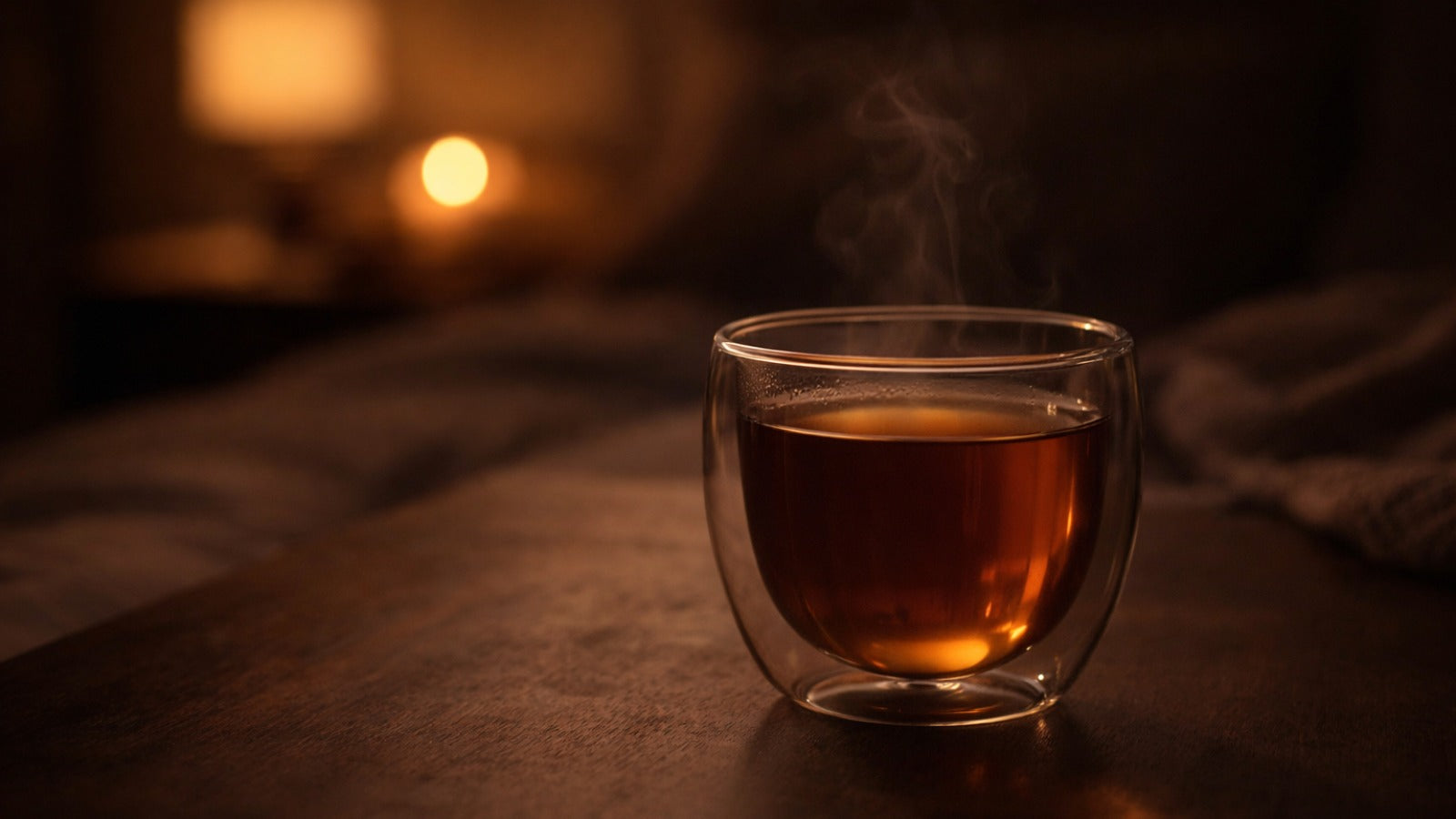
Should You Drink Herbal Tea Before Bed? The Honest Answer

Herbal tea is often a good choice before bed because it's naturally caffeine-free and doesn't introduce the stimulation that comes with coffee or traditional tea. For many people, it's a simple way to wind down without interfering with the body's natural transition into rest.
It doesn't work like a sleep aid, but it can support the conditions that make it easier to fall asleep, especially when used consistently. Whether it makes a difference depends on what you're currently drinking and how it fits into your routine. This is one part of a complete guide to herbal tea before bed.
Should You Drink Herbal Tea Before Bed?
In most cases, yes
Herbal tea is generally a good choice before bed because it doesn't contain caffeine and won't disrupt your body's natural sleep signals.

It's most useful as a replacement
If you're currently drinking coffee, soda, or caffeinated tea in the evening, switching to herbal tea can reduce stimulation and make it easier to wind down, especially if you're thinking more broadly about what to drink before bed and why herbal tea is often the better choice.
The benefit is subtle but reliable
Herbal tea doesn't force sleep. Its value comes from supporting a smoother transition into rest rather than creating a strong or immediate effect.
What the Science Says About Herbal Tea and Sleep
Several herbs commonly used in evening teas have been studied for their effects on sleep and relaxation. Chamomile contains apigenin, a compound that interacts with receptors in the brain associated with calming activity and improved sleep quality in some populations. Lavender and lemon balm, by contrast, have been linked to reduced anxiety and improved mood, both of which can support sleep.

Other herbs, such as valerian root and passionflower, have been studied for their influence on GABA, a neurotransmitter that helps regulate the nervous system. This is associated with relaxation and, in some cases, falling asleep more easily.
Most of this research uses concentrated extracts rather than standard tea preparations, so the effects of tea itself are typically milder. Even so, when you look more closely at what happens when you drink herbal tea before bed, the same underlying mechanisms still apply.
Why Herbal Tea Works Before Bed
The most consistent effect comes from what isn't in the cup. Caffeine works by blocking adenosine, the compound that builds up through the day and signals tiredness, which is why an afternoon coffee can still be keeping you awake at night. A caffeine-free herbal tea does the opposite: it leaves that natural sleep pressure intact, so nothing works against the wind-down your body is already moving toward.

Warmth adds to it. A warm drink supports a mild relaxation response and, as your body processes the heat and gradually cools, aligns with the natural temperature dip that comes with preparing for sleep. On its own, each of these is subtle. Combined with a calming herb and repeated as a nightly habit, they make the transition into evening feel easier and more consistent over time.
When and How to Drink Herbal Tea Before Bed
For most people, herbal tea works best about 20 to 30 minutes before bed, giving the body time to begin settling into a more relaxed state. The effect is typically mild and may be noticeable within 30 to 60 minutes.

Keep the process simple. Bring water to a boil, pour it over your tea, and let it steep for about 5 to 7 minutes. While it sits, take a minute to slow down. Even something as small as standing in the kitchen, waiting for the tea, and letting the moment be quiet is part of the ritual, not separate from it. Over time, that pause becomes familiar, and the body begins to recognize it as the beginning of rest.
It also helps to keep liquid intake moderate and finish your tea before getting into bed, so it doesn't interrupt the night.
Two Dessert-Inspired Evening Blends to Try
If you want to put any of this into practice, the tea itself only needs to be two things: genuinely caffeine-free and good enough that you'll actually reach for it night after night. Purely's evening blends are built for exactly that, whole botanicals, no added sugar, and enough character to make the last cup of the day worth slowing down for.
Sacred Sanctuary™ is the softer of the two, ripe fig and mellow pear rounded out with real vanilla, like a warm fruit dessert in a cup.
Moonlight Stillness™ is the deeper one, date and vanilla over a rich red rooibos base with a whisper of cardamom, the kind of warm, baked-spice sweetness you'd find in an actual dessert.
Both are caffeine-free and dairy-free. If you're not sure where to begin, the Evening Ritual Sampler includes both blends for $19, an easy way to find the one you'll reach for. The simplest place to start is just to try it tonight and see how it fits the rhythm of your evening.
A Simple Ritual to Let the Evening Settle
For most people, herbal tea becomes less about what it does and more about what it allows. It creates a small pause at the end of the day, a slower moment where the warmth, quiet, and repetition begin to feel familiar. The effect is usually mild, but that is part of its strength. It does not force sleep or push the body in any direction. It simply supports a shift that is already trying to happen.
Over time, the cup becomes a signal: the day is ending, the pace is changing, and the evening has a place to turn. That same small gesture sits at the center of a wider practice of evening tea rituals, where the focus moves away from outcome and toward a quieter transition before bed.
References
- Your Guide to Healthy Sleep — National Heart, Lung, and Blood Institute (NIH)
- Chamomile: A Herbal Medicine of the Past With Bright Future — National Library of Medicine
- Effects of Lemon Balm on Mood and Sleep — National Library of Medicine
- Lavender and the Nervous System — National Library of Medicine
- Valerian for Sleep: A Systematic Review — National Library of Medicine
- Passionflower and Sleep Quality — National Library of Medicine
- Adenosine and Sleep-Wake Regulation — National Library of Medicine
- Temperature and Sleep Regulation — National Library of Medicine
Editorial Disclaimer
This content is for informational and educational purposes only. It reflects general scientific findings and perspectives on herbal tea, sleep, and daily routines. It is not intended to provide medical advice, diagnose conditions, or recommend treatments. Always consult a qualified healthcare professional with any questions about health, sleep, or herbal ingredients, especially if you are pregnant, nursing, taking medication, or have a medical condition.