Evening Herbal Tea Ingredients: A Complete Guide

An evening blend is not a list of nice-smelling things thrown into hot water. It is built, and it is built in layers. There is a floor holding it up, a sweetness sitting on that floor, an aromatic note cutting across the top, and one or two ingredients whose entire job is to make the others get along. Take any layer out and the cup falls over.
Fourteen botanicals do nearly all the work in a good evening tea, and most of them are nothing like what you would expect. The sweetest ingredient contributes almost no flavor. The one everyone can name is the one you cannot taste. Here is what actually goes into the cup at the end of the day, what each plant is for, and why it belongs in the evening rather than the morning. If you want the wider case for drinking tea at night, that is the place to start.
The Base: What the Cup Is Built On
Nobody buys a tea for the base. It is the part nobody names, and it is the part that decides whether everything else works. Four botanicals do this job, and in a well-made evening blend you will find at least two of them.

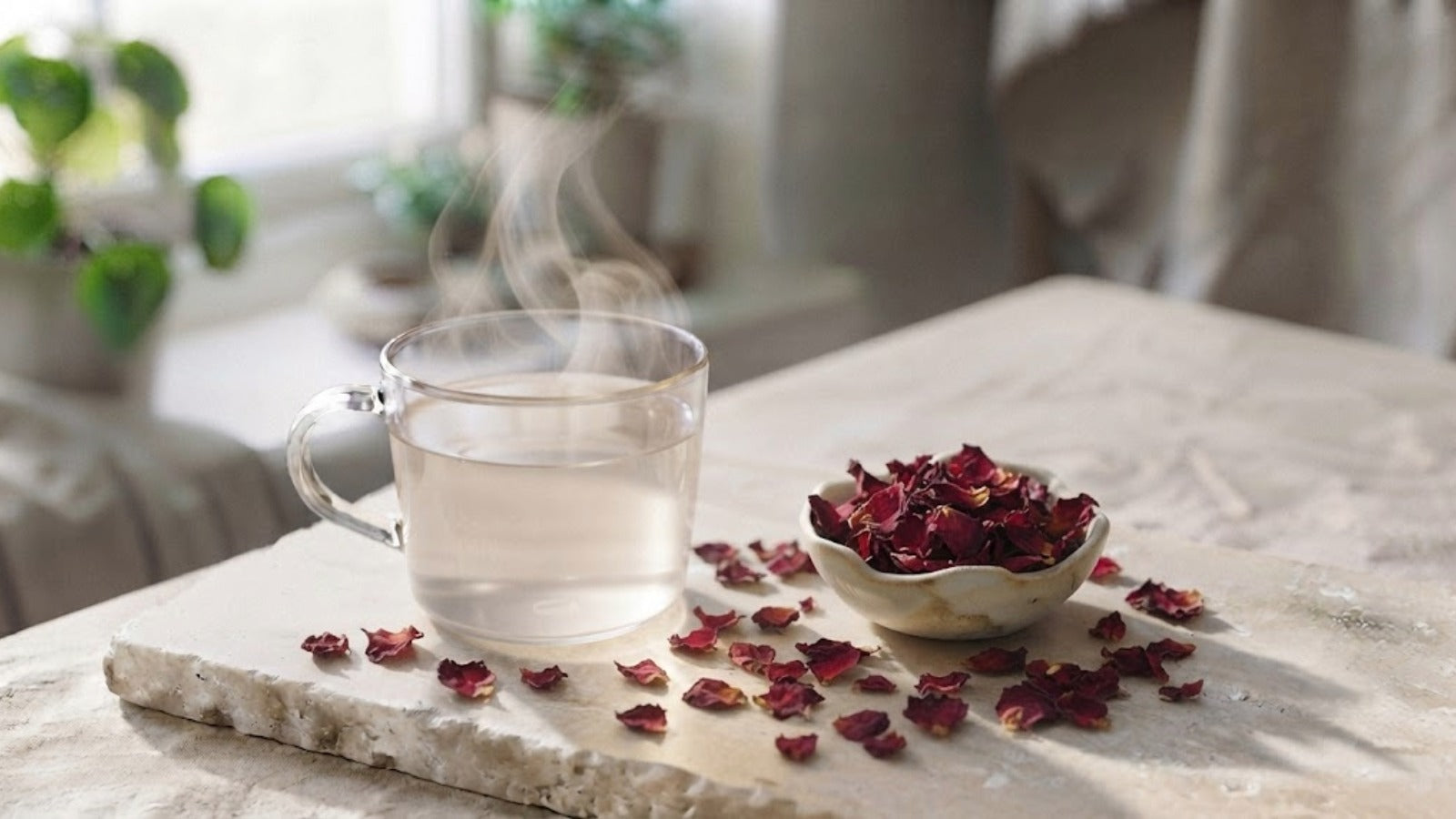
Red rooibos is the floor. It supplies the woody, faintly dry depth that everything sweet in the tea stands on, and it is the source of that deep red-amber color you see through the side of the glass. Nothing else in an evening blend makes that color. It is not sweet, despite what most people assume, and that is exactly the point: without a little earth underneath it, a fruit-forward cup tips into syrup by the third sip.
Honeybush is the sweetness. The plant is naturally, genuinely sweet, with a honeyed caramel-apricot warmth, and it is the single reason a caffeine-free herbal tea can taste like dessert without a grain of sugar in it. It is routinely confused with rooibos, its South African cousin, and the two do opposite jobs. Sweetness over earth is the architecture of nearly every evening blend worth drinking.
Marshmallow root changes the water itself. It is dense with mucilage, a plant compound that dissolves into hot liquid and thickens it, and it is the only common evening botanical that alters the physical properties of the tea rather than its flavor. You cannot taste it. You can only feel it, in the way the cup coats the mouth and lingers a half-second longer than it should.
Carob brings the roast. Dark, toasted, and cocoa-adjacent, it is the closest thing to chocolate you can reasonably drink at ten at night, because it carries none of the caffeine that comes with cacao. It sits low in a blend and gives the cup a floor to stand on, which is why a fig-and-carob tea tastes baked rather than merely fruity.
Between them these four supply structure, sweetness, body, and depth. Everything else in this guide is arranged on top of them.
The Fruit: Where the Sweetness Comes From
Fruit is what people taste and what people name. Three fruits carry the evening cup, and the mistake is to treat them as interchangeable. They are not even close. Each one has been dried to a different point, and how far you take a fruit decides what it stops being.

Fig is jam. A fresh fig is delicate and watery and barely sweet; dry it and the water leaves, the sugars concentrate, and the fruit turns dark and dense and seedy until it stops tasting like fruit and starts tasting like a preserve. It is the heaviest thing in an evening blend and the closest to a center of gravity. Fig is what makes a cup taste cooked.
Pear is the ingredient that still tastes like fruit. Light, clean, faintly floral, with a grainy orchard sweetness that survived the drying intact, it is the counterweight that keeps a dessert-leaning blend from collapsing into one dark note. It is also the hardest of the three to get right, because pear is more than eighty per cent water and most commercial drying destroys it. Bad pear tastes like nothing at all.
Date has gone past fruit entirely. Roughly two thirds sugar by weight, it is the sweetest thing most people ever eat, and in a cup it barely registers as a flavor at all. What it contributes is a quality: a syrupy density that makes the liquid feel thicker than it should and reads on the tongue as luxury before it reads as taste. You do not taste date. You notice that the tea has become a dessert.
Jam, fresh, and syrup. Three points on the same road, and a good evening blend rarely takes all three at once.
The Flowers: Aroma, Familiarity, and the Air Above the Cup
Flowers are the part of an evening blend that works on the room rather than the mouth. All three of these are common, and only one of them is difficult.

Chamomile is a forgiving botanical. Soft, hay-sweet, with a faint apple note and a clear golden infusion, it is the flower you recognize before you have thought about it, and there is almost no way to ruin it. Steep it too long and it gets a little stronger. That is the worst it will do. It is not the most interesting thing in the cabinet, and it is the one that never lets you down.
Lavender is more tempermental. Its aroma is up and out of the cup within seconds and still in the room after the tea is gone and used carefully it is the most beautiful thing in an evening blend. Used carelessly it tastes like soap. Lavender has almost no margin, which is why it works as an accent and almost never as a base, and why most people who say they dislike it have simply never had a restrained cup of it. If you are weighing the two against each other, that is a question worth answering properly: chamomile and lavender are almost nothing alike.
Linden blossom is a botanical you would never notice and could least afford to lose. Faint, honeyed, barely there on its own, it sits at almost exactly the midpoint between sweet and floral, which means it can be tasted as continuous with the fruit on one side and the flowers on the other. It is not really a flavor. It is a joiner, and its whole contribution is that everything else in the cup stops sounding like a list.
The Herbs: The Green Line Through the Sweetness
Only one herb has any real business in an evening blend, and the reason why is the most interesting thing in this guide.

Lemon balm is citrus with the volume turned down. Lemon peel, lemongrass, and lemon verbena are all bright, sharp, waking things with no business anywhere near the end of the day. Lemon balm carries the same lemon character and none of the lift, and the reason is botanical: it is not a citrus plant at all. It is a member of the mint family that happens to smell like lemon, and the resemblance comes from a much softer aromatic compound that sits back rather than lunging forward.
What that buys a blend is legibility. Evening teas are warm and sweet and rounded all the way down, and past a certain point they collapse into one undifferentiated brown sweetness. Lemon balm draws lines between things. It runs a thin green line through the middle of the cup, holds the sweetness and the spice apart, and it is the reason you can still taste the individual parts of a blend on the third night as clearly as the first.
The Spices: Warmth and the One Thing With an Edge
Two spices finish an evening blend, and they pull in opposite directions. One makes everything softer. The other is the only ingredient in the cup that is not trying to be comfortable.

Vanilla is not sweet. There is no sugar in a vanilla bean, and the compound responsible for nearly all of its character is an aromatic rather than a sweetener. What happens in a cup is stranger: your brain has spent a lifetime meeting vanilla inside ice cream and cake and custard, and it has learned to file that smell under sweet. So vanilla makes a tea taste richer, rounder, and sweeter without adding anything sweet to it, which is the most useful sleight of hand in a blender's cabinet.
Cardamom is the counterweight, and it is the ingredient most people have never actually tasted. The powder in the jar is a pale, dusty thing that has been dying since the day it was ground; the pod is a sealed container built to keep the volatile oils in, and once you break it they start leaving. Cracked fresh, cardamom is bright, resinous, and cool at the edges, and it is the only note in an evening blend with any resistance in it. In a cup made almost entirely of sugar, that resistance is the difference between a dessert and a sugar bowl.
Vanilla rounds the corners. Cardamom keeps the cup honest. A sweet evening blend needs both.
How These Botanicals Come Together
Two evening blends, fourteen botanicals, and every one of them chosen against the others. Here is what the layers actually build.
Sacred Sanctuary™ tastes like warm baked fruit lifted straight from the oven: ripe fig and soft pear folded into vanilla, jammy and rounded, sweet without weight. The carob underneath it is the oven, the lavender above it keeps the sweetness from ever closing in, and the pear is the reason a cup this rich still tastes like fruit.
Moonlight Stillness™ goes dark and slow: honeyed date, vanilla, and a thread of warm cardamom, a cup that tastes the way a candlelit room feels. The date is the syrup, the cardamom is the thread cutting through it, and the chamomile running underneath is what keeps the whole thing familiar.
Some nights call for one, other nights the other. The Evening Ritual Sampler carries both, so the evening never waits on a decision, whichever way you happen to be leaning.
Building Your Own Evening Cup
The layers are the whole thing. A base to stand on, a fruit to lead with, a flower for the air above it, something green to keep it legible, and a spice with enough edge to stop the sweetness closing over. Get those five right and the proportions almost sort themselves out. Get one wrong and no amount of the others will fix it.
Most of these plants are more interesting than their reputations, and several of them are doing the opposite of what you would assume. That is the useful part. A cup at the end of the day is a small thing, and it is worth understanding what is actually in it.
Editorial Disclaimer
This content is for informational and educational purposes only. It reflects general perspectives on herbal tea, daily rituals, and related lifestyle practices. It is not intended to provide medical advice, diagnose conditions, or recommend treatments. Always consult a qualified healthcare professional with any questions about wellness or health-related matters.